 Cipru: pentru restaurante și mâncare la pachet
Gata pentru inspecția alimentelor. În fiecare zi.
In the Republic of Cyprus the app follows EU Regulation 852/2004, the Hygiene Regulations (Κ.Δ.Π. 320/2006) and the Public Health Services hygiene guides; the Public Health Services inspect, and there is no public rating.
14 zile gratuite · un singur preț per locație · fără contract
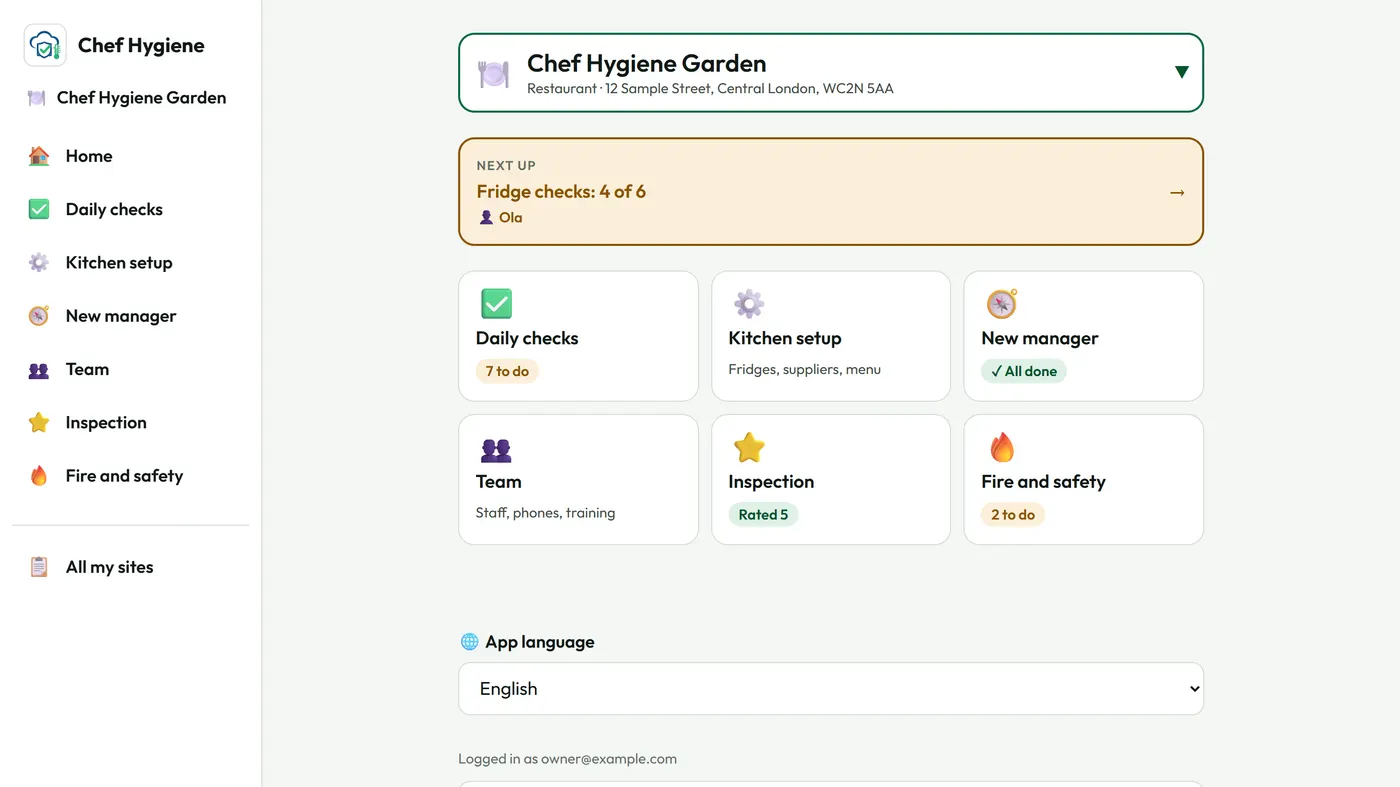
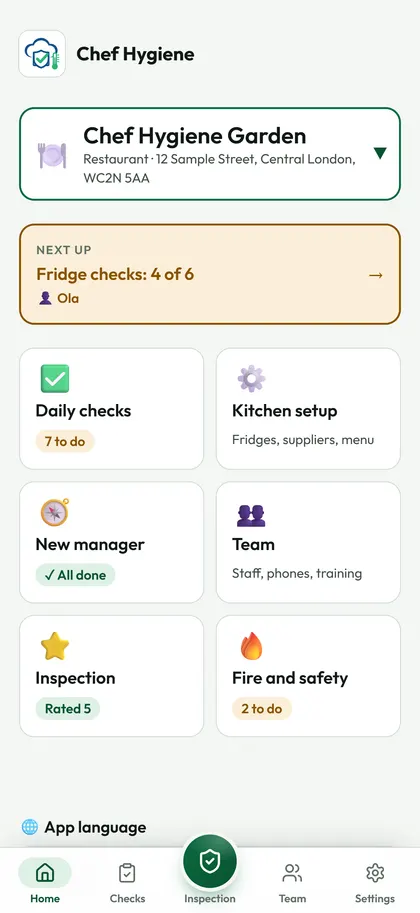
Cipru: reguli de igienă alimentară
Regulile de pe această pagină sunt deocamdată în limba engleză. Vor fi traduse în limba dumneavoastră.
- Organismul de inspecție
- Public Health Services of the Ministry of Health (Υγειονομικές Υπηρεσίες)
- Evaluare publică
- Nu
- Limbi în aplicație
- Ελληνικά, English
Inspecția dumneavoastră
The Public Health Services (Υγειονομικές Υπηρεσίες) of the Ministry of Health inspect restaurants through five district offices. Some municipal health services may inspect in their own area under Law 54(I)/1996. The Deputy Ministry of Tourism licenses restaurants under Law 29/1985, and its officers also check cleanliness.
Inspections are risk-based. Eleven risk factors give a category from 1 to 4, and the category is the number of full inspections a year. Seasonal businesses get fewer. The inspector can give written instructions, take samples, seize food, and suspend a business for up to 4 days, renewable. Administrative fines can reach €854 a day, and a court can fine, close the premises and ban trading (Law 54(I)/1996). You can object to a suspension or seizure within 3 working days.
Evaluare igienică
Cyprus has no public hygiene rating, grade or sticker, and nothing has to be displayed. The Tourism classes A, B and C describe the building and service, not hygiene.
„Legea” este o regulă obligatorie. „Îndrumările oficiale” nu sunt lege, dar inspectorii o așteaptă. „Chef Hygiene implicit” este o valoare pe care aplicația o verifică acolo unde nicio regulă nu oferă un număr.
Temperaturi
- Îndrumări oficialeNo Cyprus law sets fridge, hot-holding, cooling or reheating numbers for restaurants. The numbers below come from the Public Health Services Hygiene Guide No 1 (2nd edition) and its HACCP plan for small businesses.
- Îndrumări oficialeGuide No 1: chilled food, and raw meat, poultry and fish, at 5°C or below. The small-business plan sets a critical limit of 7°C. Chef Hygiene aims for 5°C and warns above 7°C. Cakes and pastries: 8°C at most.
- DreptQuick-frozen food must be at −18°C or colder. Brief rises of up to 3°C are allowed in transport and display (Κ.Δ.Π. 80/2002, reg. 6). Guide: never refreeze; ice cream on display at −14°C or colder.
- Îndrumări oficialeGuide No 1: cook to 75°C in the centre, or 70°C for 2 minutes. Pork and burgers: 68,3°C for 15 seconds. Frying oil never above 180°C.
- Îndrumări oficialeGuide No 1: keep hot food at 60°C or more. Below 60°C is allowed once, for serving only. The small-business plan says above 63°C.
- Îndrumări oficialeGuide No 1 for food between 5°C and 60°C: under 2 hours, chill it or eat it. From 2 to 4 hours, eat it at once. Over 4 hours, throw it away.
- Îndrumări oficialeGuide No 1: cool from 60°C to 10°C within 2 hours, never over 3 hours, then keep at 5°C or below.
- Îndrumări oficialeGuide No 1: reheat to above 75°C in the centre. No time limit is given.
- Îndrumări oficialeGuide No 1: thaw in the fridge at 5°C or below, or under running drinking water at 21°C or below for at most 3 hours.
Personal, instruire și sănătate
- DreptEveryone who touches open food needs a health certificate from a government Chief Medical Officer, renewed every 12 months. It includes a stool test for Salmonella and parasites (Κ.Δ.Π. 320/2006). Keep it ready for inspectors.
- DreptStaff who are ill tell the manager, and the manager tells the district Chief Medical Officer at once. They return to work only when that officer decides. There is no fixed number of days off (Κ.Δ.Π. 320/2006).
- DreptStaff who handle open food keep themselves clean, cover wounds with a waterproof dressing, do not smoke or spit, and wear a white coat and a head covering (Κ.Δ.Π. 320/2006).
- Îndrumări oficialeGuide No 1: all staff do Level 1 at hiring (read the Ministry’s hygiene handbook and sign a statement). Owners, managers and staff who prepare food do Level 2, a 30-hour course. No legal course or renewal is set.
- DreptStaff must be supervised and trained to suit their job (Regulation 852/2004, Annex II).
Alergeni
- DreptGive information on the 14 EU allergens for food served or sold loose (Regulation 1169/2011, art. 44).
- Îndrumări oficialePublic Health Services: loose food gives the information through labelling, and the minimum is the allergenic ingredients. Chef Hygiene asks for a written list per dish and an “ask staff” sign.
- DreptAll food information must be in Greek. Other languages may be added (Κ.Δ.Π. 262/2002, reg. 5).
- DreptFor phone and online orders, give the information before ordering and again at delivery, in Greek (Regulation 1169/2011, art. 14).
Verificări de siguranță la incendiu
- Îndrumări oficialeExtinguishers: the owner checks at least every 3 months and writes it down. A qualified firm services them every year (Κ.Δ.Π. 520/2014 code of practice).
- DreptLPG installations must be inspected by an approved gas installation inspector: every 6 years for 4 or more linked cylinders or up to 500 kg, every 5 years for 500 to 2,000 kg or food trucks, every 4 years above 2,000 kg or for tanks (Κ.Δ.Π. 189/2021). Storage of up to 200 kg and one cylinder joined straight to one appliance are exempt.
- DreptThe employer must have an emergency plan and name, train and record staff for first aid, fire fighting and evacuation. Fire equipment and alarms are tested by a competent person.
- DreptElectrical installations over 150 kVA need a registered maintainer and a register (Κ.Δ.Π. 78/2022). No fixed interval was found for smaller sites. No legal hood cleaning interval was found.
Înregistrări
- DreptHACCP-based procedures with records that fit the size of the business are required (Regulation 852/2004, art. 5).
- Îndrumări oficialePublic Health Services small-business plan: keep records of suppliers and goods-in, fridge and freezer temperatures (2–3 times a day), cooking and reheating, hot and cold display, water and ice tests, staff health certificates, cleaning, pest control with a bait map, equipment upkeep and staff training. Review the plan 1–2 times a year.
- DreptPest control by a licensed operator is required for professional biocide work (Κ.Δ.Π. 145/2019). Keep records and a bait map.
Surse oficiale
- Public Health Services, Ministry of Health
- Hygiene Regulations Κ.Δ.Π. 320/2006, CyLaw
- Food (Control and Sale) Law 54(I)/1996, CyLaw
- PHS Hygiene Guide No 1
- Business in Cyprus, restaurant licence
Checked
Această pagină conține informații generale, nu consultanță juridică. Verificați cu autoritățile locale.
Cipru: ghiduri de igiena alimentară
Configurați Chef Hygiene
Creați-vă contul, configurați o tabletă de bucătărie comună și puneți aplicația pe telefoanele personalului dvs., pas cu pas.
Cipru: inspecții alimentare
Cine vă inspectează bucătăria, cum funcționează o inspecție și dacă există un rating de igienă publică.
Cipru: regulile de temperatură a alimentelor
Temperaturile alimentelor pe care trebuie să le păstreze bucătăria ta și regulile din spatele lor.
Cipru: alergeni
Ce trebuie să spună bucătăria dvs. clienților despre alergeni.
Cipru: boala și formarea personalului
Instruire, reguli pentru manipularea alimentelor și când personalul bolnav trebuie să stea departe de alimente.
Cipru: securitate la incendiu
Verificări de siguranță la incendiu pentru bucătăria dvs. și cât de des sunt datorate.
Cipru: înregistrări de păstrat
Înregistrările și înregistrările pe care trebuie să le păstreze bucătăria dvs.
Cipru: aplicația Chef Hygiene.
Aplicația încarcă aceste reguli pentru bucătăria ta, verifică înregistrările tale în raport cu ele și păstrează dovada pentru inspector.
Alte țări
 Regatul Unit
 Irlanda
 Islanda
 Statele Unite ale Americii
 Canada
 Franța
 Spania
 Țările de Jos
 Belgia
 Portugalia
 Germania
 Austria
 Polonia
 România
 Italia
 Grecia
 Danemarca
 Elveția
 Luxemburg
 Malta
Malta Suedia
 Norvegia
 Finlanda
 Cehia
Cehia Ungaria
 Croația
 Bulgaria
 Slovacia
 Slovenia
 Estonia
 Letonia
 Lituania
 Liechtenstein
 San Marino
 Gibraltar
 Monaco
 Republica Moldova
 Andorra
 Serbia
 Jersey
 Guernsey
 Insula Man
 Turcia
 Muntenegru
 Bosnia și Herțegovina
 Kosovo
 Albania
 Macedonia de Nord
 Ucraina