 Austria: para restaurantes y comida para llevar
Listos para la inspección de alimentos. Todos los días.
In Austria the app follows the food law (LMSVG), the allergen information regulation, EU Regulation 852/2004 and the health ministry’s hygiene guideline for restaurants; your federal state’s food control inspects.
14 días gratis · un precio por sitio · sin contrato
Austria: reglas de higiene alimentaria
Las reglas de esta página están en inglés por el momento. Se traducirán a tu idioma.
- Órgano de inspección
- Food control of the federal state (Lebensmittelaufsicht); in Vienna the Market Office MA 59 (Marktamt)
- Calificación pública
- No
- Idiomas en la aplicación
- Deutsch, English
Su inspección
Food control is the task of the governor (Landeshauptmann) of each of the 9 federal states. The Land’s trained food inspectors (Lebensmittelaufsicht) do the visits; in Vienna this is the Market Office MA 59. The agency AGES tests official samples.
Controls are based on risk, under a 3-year national control plan. After a visit the inspector can ask in writing for faults to be fixed by a deadline, or issue a formal order. Orders can go as far as closing all or part of the business. Fines are up to €35,000, and up to €70,000 for repeat cases.
Calificación de higiene
Austria has no public hygiene rating or sticker. Results are not published for each business, and there is nothing to display at the door.
“Ley” es una norma vinculante. “Orientación oficial” no es ley, pero los inspectores la esperan. “Chef Hygiene predeterminado” es un valor que la aplicación comprueba cuando ninguna norma especifica un número.
Temperaturas
- Orientación oficialChilled food: 0–4°C, with a tolerance up to 6°C. Chef Hygiene aims for 4°C and flags readings above 6°C. No Austrian law sets restaurant temperatures; this is the ministry’s guideline (Beilage 1b).
- Orientación oficialRecommended maximum for restaurants: poultry, rabbit and raw mince 4°C, other meat 7°C, offal 3°C. Raw fish is kept at melting-ice temperature. A fridge with mixed food is set to the lowest temperature needed.
- Orientación oficialFrozen food: −18°C, with a tolerance up to −15°C.
- Orientación oficialHot food: as hot as possible, in any case above 70°C. A short drop is tolerated if the food stays safe. The staff leaflet says at least 75°C for hot food on offer.
- Orientación oficialCooling: cool food that is not eaten at once quickly to 0–4°C (6°C at most), if possible within 2 hours, and keep it there.
- Orientación oficialReheating: a core temperature of at least 75°C for several minutes.
- Orientación oficialCooking: hot dishes with raw egg reach 75°C in the core. Mince, poultry and fish must be well heated through; the guideline gives no number.
- Orientación oficialSalads on a buffet for more than 2 hours must be kept chilled.
- Orientación oficialDeliveries: refuse frozen food above −15°C, and chilled food more than 3°C above the product’s own set temperature. Chef Hygiene uses 7°C as one number for chilled deliveries.
Personal, formación y salud
- LeyFood workers must be supervised and trained in food hygiene for their work (EU Regulation 852/2004). Austrian law sets no certificate, hours or renewal.
- Orientación oficialThe ministry’s guideline asks for training at least once a year, at hiring and when tasks change, in a language the worker understands. Record place, date, topic, length, trainer and signatures, and keep the record for 3 years.
- Orientación oficialHealth instruction (Belehrung), oral and written with a signed form, at the start and once a year.
- Orientación oficialSick staff: no food work with diarrhoea or vomiting, infected wounds, or skin disease that cannot be covered. Stay away at least 48 hours after symptoms end, unless an infection is ruled out. Disinfect hands after every toilet visit for 3 weeks. Staff must tell you at once.
- LeyStaff who give allergen information by word of mouth must be trained, and the training must be documented (Allergeninformationsverordnung § 3).
Alérgenos
- LeyThe 14 EU allergens: cereals with gluten, crustaceans, eggs, fish, peanuts, soybeans, milk, tree nuts, celery, mustard, sesame, sulphites, lupin and molluscs.
- LeyFor food that is not prepacked, give the allergen information in writing without being asked. Or put up a clearly visible notice that staff give it by word of mouth on request (Allergeninformationsverordnung § 3).
- LeyInformation by word of mouth must come from trained staff and always be based on written records, such as recipes and supplier labels (§§ 3 and 4).
- Orientación oficialThe official Austrian Food Code (Codex A5) has letter codes A to R for the 14 allergens. You may use them only with a legend headed “Allergeninformation gemäß Codex-Empfehlung”.
Controles de seguridad contra incendios
- LeyFire extinguishers and fixed extinguishing systems are checked at least every second calendar year, and no more than 27 months apart, by a competent person. Keep the record for 3 years or use a sticker with the test date (AStV § 13).
- LeyEmergency lighting, alarm devices, ventilation and air-conditioning systems and fire alarm systems are checked every year, no more than 15 months apart. Emergency lights and escape signs are checked by eye every month (AStV § 13).
- LeyThe electrical installation is tested by an electrician at most every 5 years. The labour inspectorate can set 3 years for wet or hot areas. The RCD test button is pressed at least every 6 months unless the maker says otherwise (ESV 2012).
- LeyGas checks are set by each federal state’s own gas law, with no national interval. Vienna and Styria set none; others range from 2 to 15 years. A permitted business plant is self-checked every 5 or 6 years (GewO § 82b).
- LeyA fire safety book, fire safety rules and yearly fire drills are required only where the authority has ordered a fire safety officer (AStV §§ 43, 45).
Archivos
- LeyYou need own checks based on HACCP principles (EU Regulation 852/2004). The ministry’s guideline for restaurants says normal restaurant cooking needs no critical control points if good hygiene practice controls the hazards.
- Orientación oficialCheck fridge and freezer temperatures every working day, if possible at the start of work. Write down faults and what you did, and keep that record for 2 months past the food’s shelf life, at least 1 year.
- Orientación oficialKeep training records for 3 years. Document pest checks at least every 3 months. Review the HACCP system every year, and at the latest every 2 years.
- Orientación oficialKeep a cleaning plan, with a deep clean at least once a year, and goods-in checks of chilled and frozen deliveries.
Fuentes oficiales
- Health ministry: hygiene guidelines and Food Code (verbrauchergesundheit.gv.at)
- AGES: food safety, control plan, product warnings
- RIS: Austrian federal and state laws
- Vienna food control (MA 59)
- Labour Inspectorate (workplace safety)
Checked
Esta página contiene información general, no asesoramiento legal. Consulte con su autoridad local.
Austria: guías de higiene alimentaria
Configurar Chef Hygiene
Cree su cuenta, configure una tableta de cocina compartida y coloque la aplicación en los teléfonos de su personal, paso a paso.
Austria: inspecciones de alimentos
Quién inspecciona tu cocina, cómo funciona una inspección y si existe una calificación de higiene pública.
Austria: reglas de temperatura de los alimentos
Las temperaturas de los alimentos que debe mantener su cocina y las reglas detrás de ellas.
Austria: alérgenos
Lo que su cocina debe informar a los clientes sobre los alérgenos.
Austria: enfermedad y formación del personal
Capacitación, reglas para manipuladores de alimentos y cuándo el personal enfermo debe mantenerse alejado de los alimentos.
Austria: seguridad contra incendios
Controles de seguridad contra incendios en su cocina y con qué frecuencia deben realizarse.
Austria: registros para mantener
Los registros y registros que debe llevar tu cocina.
Austria: la aplicación Chef Hygiene
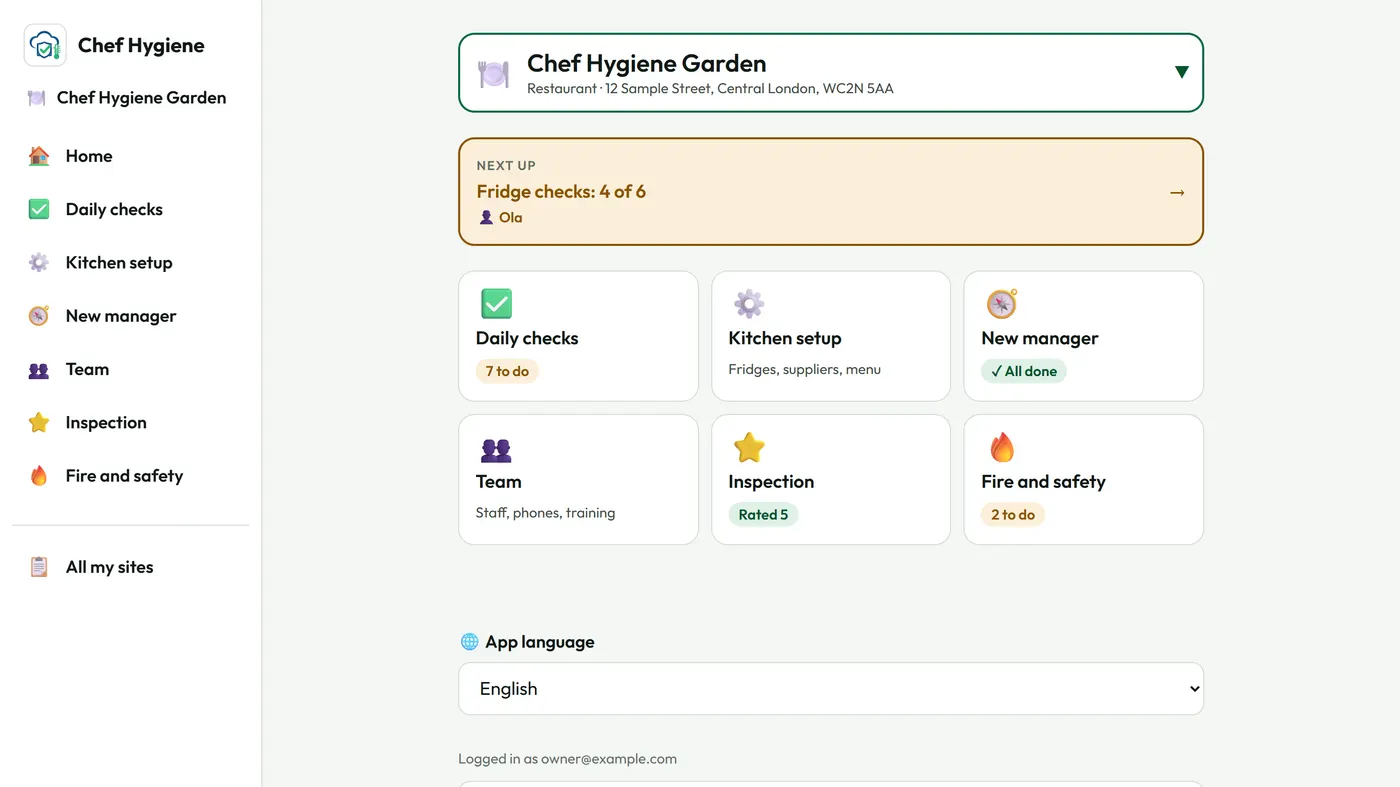
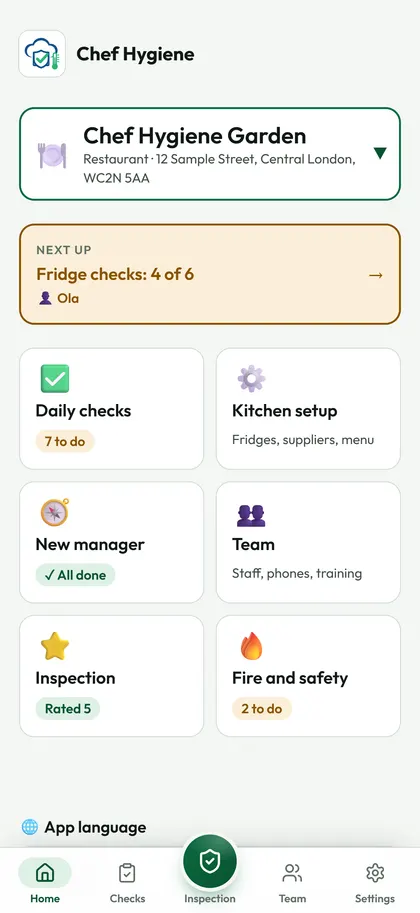
La aplicación carga estas normas para tu cocina, compara tus registros con ellas y guarda pruebas para el inspector.
Otros países
 Reino Unido
 Irlanda
 Islandia
 Estados Unidos
 Canadá
 Francia
 España
 Países Bajos
 Bélgica
 Portugal
 Alemania
 Polonia
 Rumanía
 Italia
 Grecia
 Dinamarca
 Suiza
Suiza Luxemburgo
 Chipre
 Malta
Malta Suecia
 Noruega
 Finlandia
 Chequia
 Hungría
 Croacia
 Bulgaria
 Eslovaquia
 Eslovenia
 Estonia
 Letonia
 Lituania
 Liechtenstein
 San Marino
 Gibraltar
 Mónaco
 Moldavia
 Andorra
 Serbia
 Jersey
 Guernesey
 Isla de Man
 Turquía
 Montenegro
 Bosnia y Herzegovina
 Kosovo
 Albania
 Macedonia del Norte
 Ucrania