 Italia: para restaurantes y comida para llevar
Listos para la inspección de alimentos. Todos los días.
In Italy the app follows EU Regulation 852/2004, the allergen decree D.Lgs. 231/2017 and the guidance of the regions and local health authorities (ASL); the ASL food hygiene service (SIAN) inspects.
14 días gratis · un precio por sitio · sin contrato
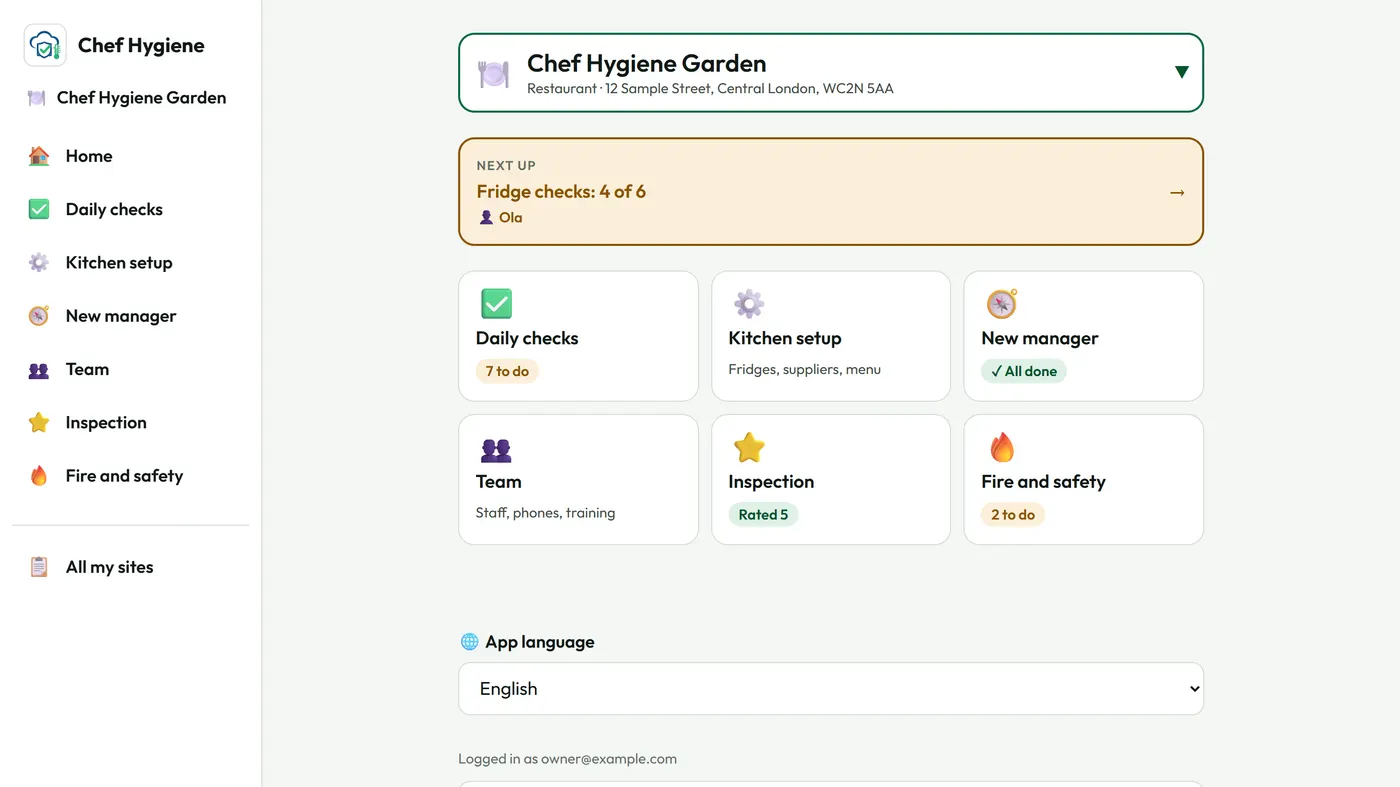
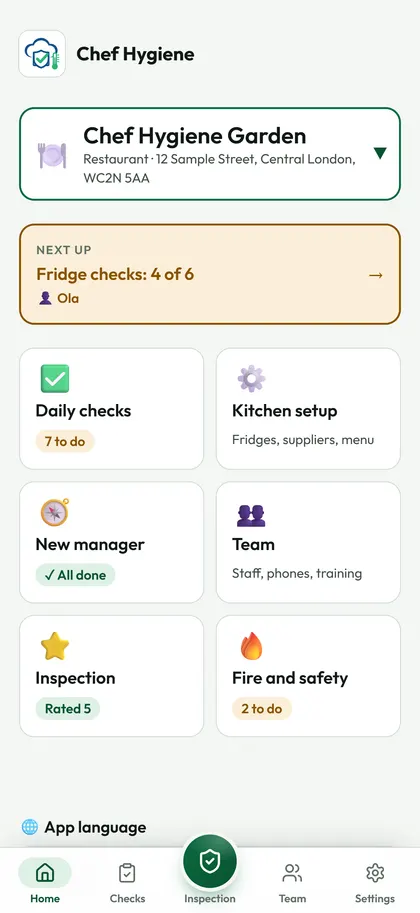
Italia: reglas de higiene alimentaria
Las reglas de esta página están en inglés por el momento. Se traducirán a tu idioma.
- Órgano de inspección
- Local health authority (ASL, Azienda Sanitaria Locale), food hygiene service SIAN
- Calificación pública
- No
- Idiomas en la aplicación
- Italiano, English
Su inspección
The local health authority (ASL) inspects restaurants through its food hygiene service (SIAN). It has other names in some regions: ATS in Lombardy, ULSS in Veneto and ASP in Sicily. The Carabinieri NAS, a health unit of the military police, can also inspect and tells the ASL what it finds.
Visits are based on risk. A new restaurant notifies the ASL through the town’s one-stop desk (SUAP). Fines include €1,500–9,000 for no registration, €500–3,000 for breaking hygiene rules and €1,000–6,000 for no HACCP-based procedures. The ASL can stop all or part of the business, and selling food in a bad state of preservation is a crime.
Calificación de higiene
Italy has no public hygiene rating or sticker. Inspection results are not published for each business, and nothing has to be displayed.
“Ley” es una norma vinculante. “Orientación oficial” no es ley, pero los inspectores la esperan. “Chef Hygiene predeterminado” es un valor que la aplicación comprueba cuando ninguna norma especifica un número.
Temperaturas
- Orientación oficialChef Hygiene checks fridges against 4°C. Local health authorities use a cold chain of 4°C (AUSL Bologna) and 0–4°C (ATS Brianza). Older national rules, whose status is disputed since 2021, allow cooked food eaten cold and filled fresh pasta up to 10°C.
- LeyQuick-frozen food: −18°C or colder in every part of the product, with short rises of up to 3°C in transport and display (D.Lgs. 110/1992, art. 4).
- Orientación oficialHot food: 60–65°C, and below 60°C it may not be served (Regione Veneto, 2021; older decree DPR 327/1980).
- Orientación oficialCooling: Italian and EU law only say to cool food as quickly as possible. Without a blast chiller (ATS Brianza, 2023) go from 65°C to 21°C within 2 hours, then to 5°C within 6 hours in all.
- Orientación oficialCooling with a blast chiller (Regione Veneto, 2021): 10°C in the centre within 2 hours of cooking, then 4°C within 2 more hours.
- Orientación oficialReheating: no law sets a number. The centre reaches 75°C (ATS Brianza); Regione Veneto says at least 70°C. Chef Hygiene warns on a reading below 75°C.
- Orientación oficialCooking: no law sets a core temperature. Regione Veneto gives 75°C in the centre as an example.
- LeyDeliveries: suppliers must keep meat at 7°C or colder, offal 3°C, poultry 4°C, mince 2°C, meat preparations 4°C, and fish near melting ice (Regulation 853/2004). Chef Hygiene checks chilled deliveries against 4°C and flags frozen ones above −15°C.
- LeyFish eaten raw or almost raw: freeze at −20°C or colder for at least 24 hours, or −35°C or colder for at least 15 hours (Regulation 853/2004).
Personal, formación y salud
- LeyItalian national law sets no food hygiene certificate, hours or renewal. The business must make sure staff are supervised and trained for their work (EU Regulation 852/2004). The old health booklet (libretto sanitario) ended in March 2021.
- LeyEach region sets its own training rules. In Lombardy the business trains its own staff with no set hours. In Emilia-Romagna there has been no regional course since 26 July 2025.
- LeyTuscany: everyone takes a 2-hour Module A; cooks, pizza makers and bartenders add a 4-hour Module B; owners and HACCP managers add an 8-hour Module C. Level 2 staff and managers do a 3-hour refresher every 5 years (regional decision DGR 540/2024).
- LeyFire wardens trained by the employer: 4 hours (level 1) or 8 hours (level 2), with a refresher at least every 5 years. First aid staff repeat their training at least every 3 years.
- LeySick staff: anyone with a disease that can pass through food, infected wounds, skin infections or diarrhoea must not handle food, and must tell the business at once (EU Regulation 852/2004).
Alérgenos
- LeyThe 14 EU allergens: cereals with gluten, crustaceans, eggs, fish, peanuts, soybeans, milk, tree nuts, celery, mustard, sesame, sulphites, lupin and molluscs.
- LeyFor each dish, show the allergens before it is served: on the menu, a register, a sign or a digital system kept in view. A digital system also needs the information on paper that the inspector and guests can easily find (D.Lgs. 231/2017, art. 19).
- LeyOr put a notice on the menu, register or sign telling guests to ask staff. Written allergen sheets must then be easy to find for the inspector and guests. The information must be in Italian, clear and readable.
- LeyFines: no allergen information €3,000–24,000; information given in the wrong way €1,000–8,000; formal faults only €500–4,000 (D.Lgs. 231/2017, art. 23).
Controles de seguridad contra incendios
- LeyFire extinguisher checks and maintenance follow the technical standards and the maker’s instructions, and every check is recorded (decree DM 1 September 2021). The technician’s periodic check is every 6 months under standard UNI 9994-1; this is usual practice.
- LeyThe earthing system and any lightning protection are checked every 5 years, or every 2 years in places at higher fire risk. The ASL, ARPA or an authorised body does it (DPR 462/2001, art. 4).
- LeyGas boilers for heating or hot water get an efficiency check every 4 years (10–100 kW) or every 2 years (100 kW or more) (DPR 74/2013). No national law sets an interval for gas cooking appliances; a qualified installer fits them and maintenance follows the maker’s instructions.
- LeyBars and restaurants do not need a fire prevention certificate. Attached activities do, for example a heat plant over 116 kW (DPR 151/2011).
- LeyEvery employer does a fire risk assessment. An emergency plan is needed with 10 or more workers, or with more than 50 people present at once.
Archivos
- LeyYou must have self-check (autocontrollo) procedures based on HACCP principles (EU Regulation 852/2004, art. 5). Having none costs €1,000–6,000, and so does not applying them correctly (D.Lgs. 193/2007).
- Orientación oficialKeep temperature logs, cleaning logs, pest control reports, supplier and batch records, equipment maintenance records and staff training records.
- LeyNo national keeping period exists. EU law says to keep records for an appropriate period. In Tuscany, a business that runs its own staff courses keeps the course papers at least 10 years.
Fuentes oficiales
- Ministry of Health (Ministero della Salute)
- Normattiva: Italian laws in force
- Fire brigade (Vigili del Fuoco)
- One-stop desk for businesses (SUAP)
- Carabinieri (NAS health unit)
Checked
Esta página contiene información general, no asesoramiento legal. Consulte con su autoridad local.
Italia: guías de higiene alimentaria
Configurar Chef Hygiene
Cree su cuenta, configure una tableta de cocina compartida y coloque la aplicación en los teléfonos de su personal, paso a paso.
Italia: inspecciones de alimentos
Quién inspecciona tu cocina, cómo funciona una inspección y si existe una calificación de higiene pública.
Italia: reglas de temperatura de los alimentos
Las temperaturas de los alimentos que debe mantener su cocina y las reglas detrás de ellas.
Italia: alérgenos
Lo que su cocina debe informar a los clientes sobre los alérgenos.
Italia: enfermedad y formación del personal
Capacitación, reglas para manipuladores de alimentos y cuándo el personal enfermo debe mantenerse alejado de los alimentos.
Italia: seguridad contra incendios
Controles de seguridad contra incendios en su cocina y con qué frecuencia deben realizarse.
Italia: registros para mantener
Los registros y registros que debe llevar tu cocina.
Italia: la aplicación Chef Hygiene
La aplicación carga estas normas para tu cocina, compara tus registros con ellas y guarda pruebas para el inspector.
Otros países
 Reino Unido
 Irlanda
 Islandia
 Estados Unidos
 Canadá
 Francia
 España
 Países Bajos
 Bélgica
 Portugal
 Alemania
 Austria
 Polonia
 Rumanía
 Grecia
 Dinamarca
 Suiza
Suiza Luxemburgo
 Chipre
 Malta
Malta Suecia
 Noruega
 Finlandia
 Chequia
 Hungría
 Croacia
 Bulgaria
 Eslovaquia
 Eslovenia
 Estonia
 Letonia
 Lituania
 Liechtenstein
 San Marino
 Gibraltar
 Mónaco
 Moldavia
 Andorra
 Serbia
 Jersey
 Guernesey
 Isla de Man
 Turquía
 Montenegro
 Bosnia y Herzegovina
 Kosovo
 Albania
 Macedonia del Norte
 Ucrania