 Liechtenstein: para restaurantes e delivery
Pronto para a inspeção sanitária. Todos os dias.
In Liechtenstein the app follows Swiss federal food law, which applies through the 1923 Customs Treaty, so the hygiene rules match Switzerland; the ALKVW inspects.
14 dias grátis · preço único por site · sem contrato
Liechtenstein: regras de higiene alimentar
As regras desta página estão em inglês por enquanto. Elas serão traduzidas para o seu idioma.
- Órgão de inspeção
- Office of Food Control and Veterinary Affairs (Amt für Lebensmittelkontrolle und Veterinärwesen, ALKVW)
- Classificação pública
- Não
- Idiomas disponíveis no aplicativo
- Deutsch, English
Sua inspeção
The Office of Food Control and Veterinary Affairs (ALKVW) inspects (LMKV art. 3). Inspections are risk-based, regular and unannounced (LMKV arts. 8 and 9).
After a visit you get a written result and, if needed, a Beanstandung (complaint), orders, or a ban on rooms, equipment or a process. If health is in immediate serious danger, the business can be closed at once (Swiss LMG arts. 34–36). You can object within 10 days (Einsprache) and appeal within 30 days (Beschwerde). Food-rule fines go up to CHF 40,000 for intent and CHF 20,000 for negligence (Swiss LMG art. 64). Before opening you need a trade licence (Gewerbebewilligung) from the AVW, and a food-business notification to the ALKVW.
Classificação de higiene
Liechtenstein has no public hygiene rating, sticker or score that the research found, and nothing has to be displayed. The aim is a visit with no faults.
“Lei” é uma regra vinculativa. “Orientação oficial” não é lei, mas os inspetores esperam que seja. “Chef Hygiene padrão” é um valor que o aplicativo verifica quando nenhuma regra fornece um número.
Temperaturas
- LeiFrozen food at −18°C or colder, and the surface never above −15°C (Swiss HyV art. 25).
- Orientações oficiaisThe law sets no plain fridge number (HyV art. 24). The GVG restaurant guide says perishable food at 5°C or colder. Fish at 2°C or colder (HyV art. 44). Chef Hygiene aims for 4°C.
- Orientações oficiaisCooking: core at 70°C or more, held at least 2 minutes (GVG guide). Pink meat is an exception.
- Orientações oficiaisHot holding: core at 65°C or more for at most 3 hours (GVG guide). The law says only “temperatures that prevent growth” (HyV art. 27).
- Orientações oficiaisCooling: from 65°C to below 5°C within 90 minutes (GVG guide). The law says “as fast as possible” (HyV art. 27).
- Orientações oficiaisReheating: core at 70°C or more, held at least 2 minutes (GVG guide).
- Chef Hygiene padrãoCold display: Chef Hygiene uses 30 minutes, then throw the food away. This is the app’s default. It also asks for fridge checks twice a day.
Equipe, treinamento e saúde
- LeiStaff must be instructed or trained for their work. Whoever runs the HACCP procedures needs HACCP training (HyV art. 22). There is no certificate, hours or renewal period.
- LeiThere is no health certificate or routine health check for food staff. Staff only have to report illness (HyV art. 21).
- LeiAnyone with an acute food-borne illness must stay out of food areas. Carriers and people with infected wounds are banned unless hygiene rules out contamination. Report illness to the responsible person at once (HyV art. 21). Chef Hygiene uses 48 hours without symptoms.
Alérgenos
- LeiAllergen information on the 14 EU allergens is mandatory. Give it on the menu or a poster, or orally only with a clearly visible written notice and written details for staff (LIV art. 5; LGV art. 39).
- LeiThe origin of meat and fish must be given in writing (LGV art. 39).
Verificações de segurança contra incêndio
- Orientações oficiaisFire exits must be free and marked (VKF fire rules). The research found no Liechtenstein interval for extinguishers, fire alarm, drills or gas.
- Chef Hygiene padrãoChef Hygiene suggests the maker’s servicing for extinguishers, with dates recorded, and a yearly check. This is the app’s default; you can edit it.
- LeiElectrics: the Starkstrominspektorat is the control body. Special installations with a restricted permit are checked every 5 years, and others by sample checks (NIV arts. 28–29). No interval for restaurants is set. Chef Hygiene suggests 5 years.
Registros
- LeiHACCP-based procedures are required, with records that fit the size of the business (HyV; EU-style HACCP rules applied through Swiss law).
- Chef Hygiene padrãoChef Hygiene asks for temperature checks twice a day, more than the GVG guide’s daily look and weekly record.
Fontes oficiais
- ALKVW, legal basis (llv.li)
- Food Control Ordinance LMKV (gesetze.li)
- Trade Act GewG (gesetze.li)
- Electrical Installations Ordinance NIV (gesetze.li)
- Swiss Hygiene Ordinance HyV (Fedlex)
Checked
Esta página contém informações gerais e não constitui aconselhamento jurídico. Consulte a sua autoridade local.
Liechtenstein: guias de higiene alimentar
Configurar Chef Hygiene
Crie sua conta, configure um tablet de cozinha compartilhada e coloque o aplicativo nos telefones de sua equipe, passo a passo.
Liechtenstein: inspeções de alimentos
Quem fiscaliza sua cozinha, como funciona a fiscalização e se existe classificação de higiene pública.
Liechtenstein: regras de temperatura dos alimentos
As temperaturas dos alimentos que sua cozinha deve manter e as regras por trás delas.
Liechtenstein: alérgenos
O que sua cozinha deve informar aos clientes sobre alérgenos.
Liechtenstein: doença e treinamento do pessoal
Treinamento, regras para manipuladores de alimentos e quando a equipe doente deve ficar longe dos alimentos.
Liechtenstein: segurança contra incêndio
Verificações de segurança contra incêndio em sua cozinha e com que frequência.
Liechtenstein: registros a serem mantidos
Os registros e registros que sua cozinha deve manter.
Liechtenstein: o aplicativo Chef Hygiene
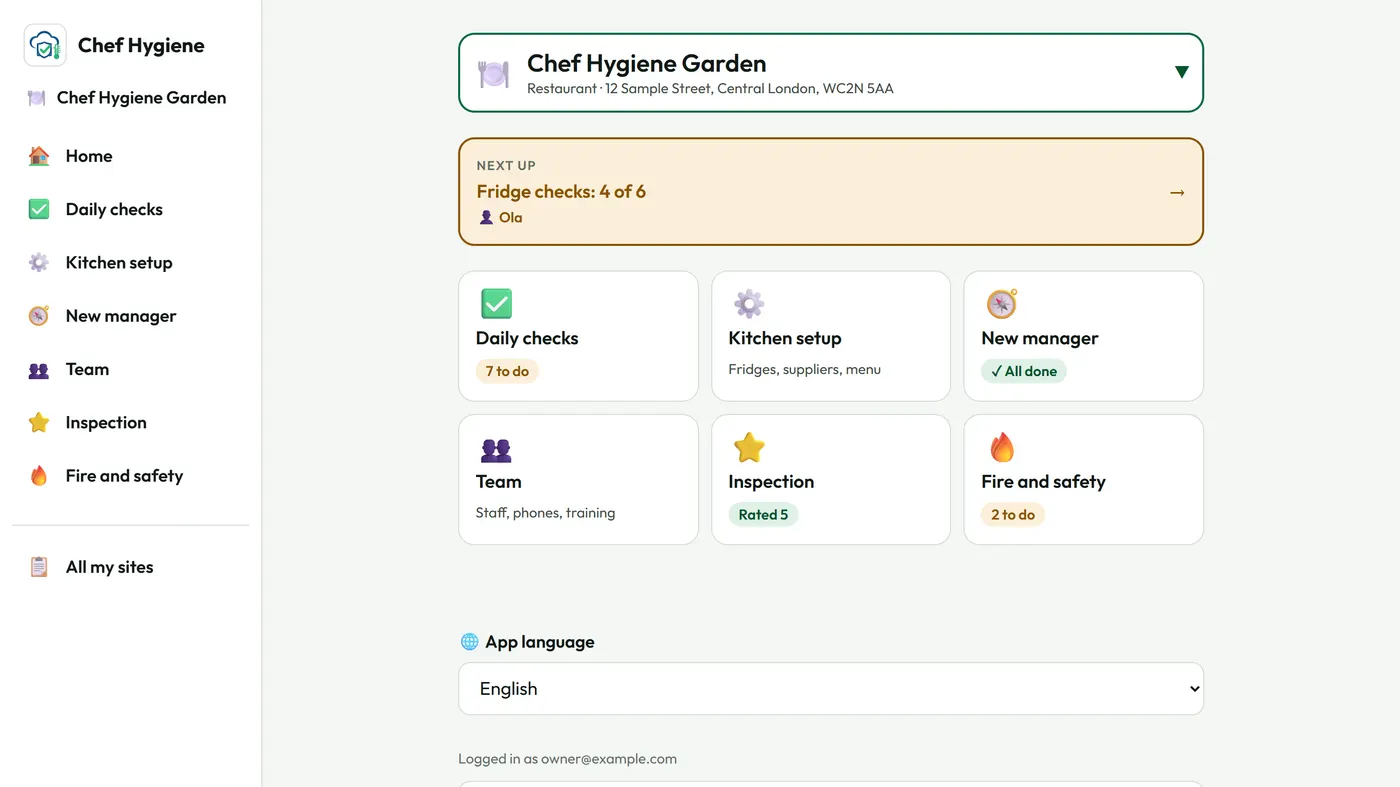
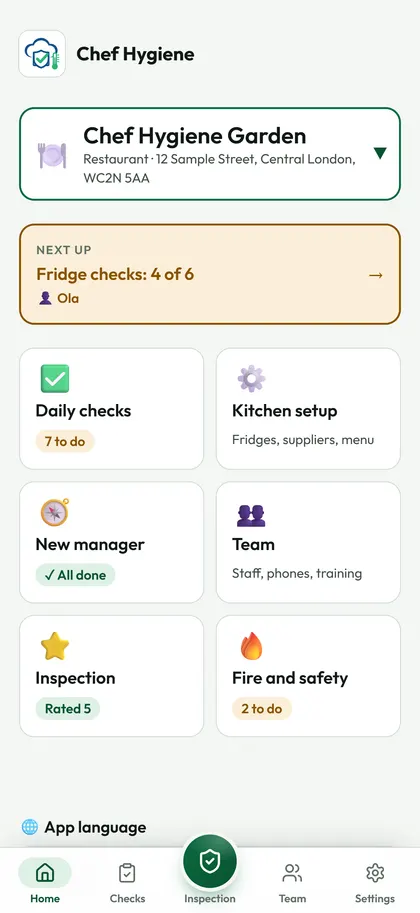
O aplicativo carrega essas regras para sua cozinha, compara seus registros com elas e guarda comprovantes para o inspetor.
Outros países
 Reino Unido
 Irlanda
 Islândia
 Estados Unidos
 Canadá
 França
 Espanha
 Países Baixos
 Bélgica
 Portugal
 Alemanha
 Áustria
 Polônia
 Romênia
 Itália
 Grécia
 Dinamarca
 Suíça
Suíça Luxemburgo
 Chipre
 Malta
Malta Suécia
 Noruega
 Finlândia
 Tchéquia
 Hungria
 Croácia
 Bulgária
 Eslováquia
 Eslovênia
 Estônia
 Letônia
 Lituânia
 San Marino
 Gibraltar
 Mônaco
 Moldávia
 Andorra
 Sérvia
 Jersey
 Guernsey
 Ilha de Man
 Turquia
 Montenegro
 Bósnia e Herzegovina
 Kosovo
 Albânia
 Macedônia do Norte
 Ucrânia