 Áustria: para restaurantes e delivery
Pronto para a inspeção sanitária. Todos os dias.
In Austria the app follows the food law (LMSVG), the allergen information regulation, EU Regulation 852/2004 and the health ministry’s hygiene guideline for restaurants; your federal state’s food control inspects.
14 dias grátis · preço único por site · sem contrato
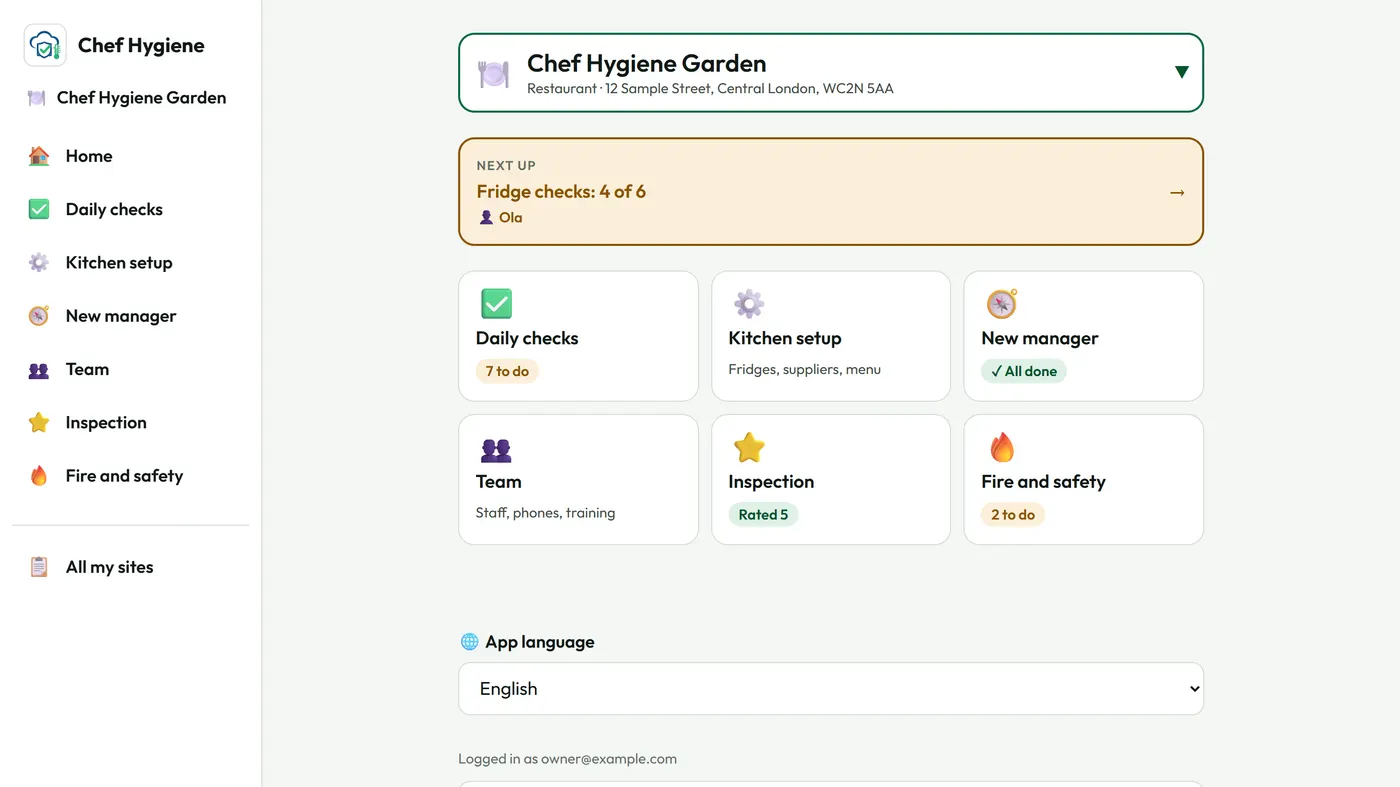
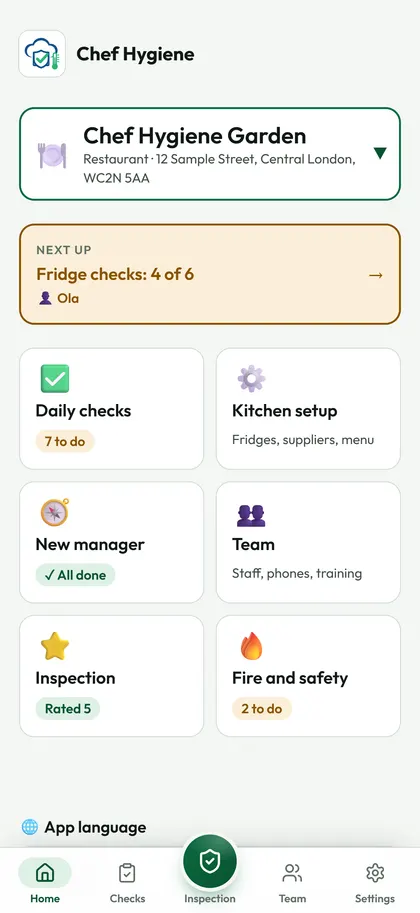
Áustria: regras de higiene alimentar
As regras desta página estão em inglês por enquanto. Elas serão traduzidas para o seu idioma.
- Órgão de inspeção
- Food control of the federal state (Lebensmittelaufsicht); in Vienna the Market Office MA 59 (Marktamt)
- Classificação pública
- Não
- Idiomas disponíveis no aplicativo
- Deutsch, English
Sua inspeção
Food control is the task of the governor (Landeshauptmann) of each of the 9 federal states. The Land’s trained food inspectors (Lebensmittelaufsicht) do the visits; in Vienna this is the Market Office MA 59. The agency AGES tests official samples.
Controls are based on risk, under a 3-year national control plan. After a visit the inspector can ask in writing for faults to be fixed by a deadline, or issue a formal order. Orders can go as far as closing all or part of the business. Fines are up to €35,000, and up to €70,000 for repeat cases.
Classificação de higiene
Austria has no public hygiene rating or sticker. Results are not published for each business, and there is nothing to display at the door.
“Lei” é uma regra vinculativa. “Orientação oficial” não é lei, mas os inspetores esperam que seja. “Chef Hygiene padrão” é um valor que o aplicativo verifica quando nenhuma regra fornece um número.
Temperaturas
- Orientações oficiaisChilled food: 0–4°C, with a tolerance up to 6°C. Chef Hygiene aims for 4°C and flags readings above 6°C. No Austrian law sets restaurant temperatures; this is the ministry’s guideline (Beilage 1b).
- Orientações oficiaisRecommended maximum for restaurants: poultry, rabbit and raw mince 4°C, other meat 7°C, offal 3°C. Raw fish is kept at melting-ice temperature. A fridge with mixed food is set to the lowest temperature needed.
- Orientações oficiaisFrozen food: −18°C, with a tolerance up to −15°C.
- Orientações oficiaisHot food: as hot as possible, in any case above 70°C. A short drop is tolerated if the food stays safe. The staff leaflet says at least 75°C for hot food on offer.
- Orientações oficiaisCooling: cool food that is not eaten at once quickly to 0–4°C (6°C at most), if possible within 2 hours, and keep it there.
- Orientações oficiaisReheating: a core temperature of at least 75°C for several minutes.
- Orientações oficiaisCooking: hot dishes with raw egg reach 75°C in the core. Mince, poultry and fish must be well heated through; the guideline gives no number.
- Orientações oficiaisSalads on a buffet for more than 2 hours must be kept chilled.
- Orientações oficiaisDeliveries: refuse frozen food above −15°C, and chilled food more than 3°C above the product’s own set temperature. Chef Hygiene uses 7°C as one number for chilled deliveries.
Equipe, treinamento e saúde
- LeiFood workers must be supervised and trained in food hygiene for their work (EU Regulation 852/2004). Austrian law sets no certificate, hours or renewal.
- Orientações oficiaisThe ministry’s guideline asks for training at least once a year, at hiring and when tasks change, in a language the worker understands. Record place, date, topic, length, trainer and signatures, and keep the record for 3 years.
- Orientações oficiaisHealth instruction (Belehrung), oral and written with a signed form, at the start and once a year.
- Orientações oficiaisSick staff: no food work with diarrhoea or vomiting, infected wounds, or skin disease that cannot be covered. Stay away at least 48 hours after symptoms end, unless an infection is ruled out. Disinfect hands after every toilet visit for 3 weeks. Staff must tell you at once.
- LeiStaff who give allergen information by word of mouth must be trained, and the training must be documented (Allergeninformationsverordnung § 3).
Alérgenos
- LeiThe 14 EU allergens: cereals with gluten, crustaceans, eggs, fish, peanuts, soybeans, milk, tree nuts, celery, mustard, sesame, sulphites, lupin and molluscs.
- LeiFor food that is not prepacked, give the allergen information in writing without being asked. Or put up a clearly visible notice that staff give it by word of mouth on request (Allergeninformationsverordnung § 3).
- LeiInformation by word of mouth must come from trained staff and always be based on written records, such as recipes and supplier labels (§§ 3 and 4).
- Orientações oficiaisThe official Austrian Food Code (Codex A5) has letter codes A to R for the 14 allergens. You may use them only with a legend headed “Allergeninformation gemäß Codex-Empfehlung”.
Verificações de segurança contra incêndio
- LeiFire extinguishers and fixed extinguishing systems are checked at least every second calendar year, and no more than 27 months apart, by a competent person. Keep the record for 3 years or use a sticker with the test date (AStV § 13).
- LeiEmergency lighting, alarm devices, ventilation and air-conditioning systems and fire alarm systems are checked every year, no more than 15 months apart. Emergency lights and escape signs are checked by eye every month (AStV § 13).
- LeiThe electrical installation is tested by an electrician at most every 5 years. The labour inspectorate can set 3 years for wet or hot areas. The RCD test button is pressed at least every 6 months unless the maker says otherwise (ESV 2012).
- LeiGas checks are set by each federal state’s own gas law, with no national interval. Vienna and Styria set none; others range from 2 to 15 years. A permitted business plant is self-checked every 5 or 6 years (GewO § 82b).
- LeiA fire safety book, fire safety rules and yearly fire drills are required only where the authority has ordered a fire safety officer (AStV §§ 43, 45).
Registros
- LeiYou need own checks based on HACCP principles (EU Regulation 852/2004). The ministry’s guideline for restaurants says normal restaurant cooking needs no critical control points if good hygiene practice controls the hazards.
- Orientações oficiaisCheck fridge and freezer temperatures every working day, if possible at the start of work. Write down faults and what you did, and keep that record for 2 months past the food’s shelf life, at least 1 year.
- Orientações oficiaisKeep training records for 3 years. Document pest checks at least every 3 months. Review the HACCP system every year, and at the latest every 2 years.
- Orientações oficiaisKeep a cleaning plan, with a deep clean at least once a year, and goods-in checks of chilled and frozen deliveries.
Fontes oficiais
- Health ministry: hygiene guidelines and Food Code (verbrauchergesundheit.gv.at)
- AGES: food safety, control plan, product warnings
- RIS: Austrian federal and state laws
- Vienna food control (MA 59)
- Labour Inspectorate (workplace safety)
Checked
Esta página contém informações gerais e não constitui aconselhamento jurídico. Consulte a sua autoridade local.
Áustria: guias de higiene alimentar
Configurar Chef Hygiene
Crie sua conta, configure um tablet de cozinha compartilhada e coloque o aplicativo nos telefones de sua equipe, passo a passo.
Áustria: inspeções de alimentos
Quem fiscaliza sua cozinha, como funciona a fiscalização e se existe classificação de higiene pública.
Áustria: regras de temperatura dos alimentos
As temperaturas dos alimentos que sua cozinha deve manter e as regras por trás delas.
Áustria: alérgenos
O que sua cozinha deve informar aos clientes sobre alérgenos.
Áustria: doença e treinamento do pessoal
Treinamento, regras para manipuladores de alimentos e quando a equipe doente deve ficar longe dos alimentos.
Áustria: segurança contra incêndio
Verificações de segurança contra incêndio em sua cozinha e com que frequência.
Áustria: registros a serem mantidos
Os registros e registros que sua cozinha deve manter.
Áustria: o aplicativo Chef Hygiene
O aplicativo carrega essas regras para sua cozinha, compara seus registros com elas e guarda comprovantes para o inspetor.
Outros países
 Reino Unido
 Irlanda
 Islândia
 Estados Unidos
 Canadá
 França
 Espanha
 Países Baixos
 Bélgica
 Portugal
 Alemanha
 Polônia
 Romênia
 Itália
 Grécia
 Dinamarca
 Suíça
Suíça Luxemburgo
 Chipre
 Malta
Malta Suécia
 Noruega
 Finlândia
 Tchéquia
 Hungria
 Croácia
 Bulgária
 Eslováquia
 Eslovênia
 Estônia
 Letônia
 Lituânia
 Liechtenstein
 San Marino
 Gibraltar
 Mônaco
 Moldávia
 Andorra
 Sérvia
 Jersey
 Guernsey
 Ilha de Man
 Turquia
 Montenegro
 Bósnia e Herzegovina
 Kosovo
 Albânia
 Macedônia do Norte
 Ucrânia