 Spain: for restaurants and takeaways
Ready for the food inspection. Every day.
In Spain, Chef Hygiene follows Real Decreto 3484/2000 on prepared meals, Real Decreto 126/2015 on allergens and EU Regulation 852/2004; the autonomous communities and town councils inspect restaurants.
14 days free · one price per site · no contract
Spain: food hygiene rules
- Inspection body
- Spanish Agency for Food Safety and Nutrition (Agencia Española de Seguridad Alimentaria y Nutrición, AESAN)
- Public rating
- No
- Languages in the app
- Español, English
Your inspection
AESAN coordinates national food safety policy and gives guidance, but it does not inspect restaurants itself. The autonomous communities (such as Catalonia, Madrid and Andalusia) and the town councils carry out the on-site inspections. Each region has its own health department.
Faults are graded as minor, serious or very serious (Ley 17/2011 and regional laws). A minor fault can bring a warning or a small fine. Serious faults bring higher fines and corrective action, and can lead to temporary closure (cierre cautelar). The owner can appeal.
Hygiene rating
There is no national public hygiene rating, sticker or star system. Some regions or town councils publish inspection results online, but this is not the same across Spain.
“Law” is a binding rule. “Official guidance” is not law, but inspectors expect it. “Chef Hygiene default” is a value the app checks against where no rule gives a number.
Temperatures
- LawChilled food kept more than 24 hours: 4°C or colder (Real Decreto 3484/2000, article 7). Chef Hygiene aims for 4°C.
- LawChilled food eaten within 24 hours: up to 8°C is allowed (article 7).
- LawFrozen food: −18°C or colder (article 7).
- LawHot food held for service: 65°C or hotter (article 7).
- LawCooling: cooked food to be kept cold must reach 8°C or colder in the centre as fast as possible (article 6.8). The decree gives no time limit.
- Chef Hygiene defaultChef Hygiene aims for cooling within 2 hours, a time the regional guides commonly use.
- LawReheating: to 65°C or hotter in the centre, as fast as possible (article 6.9). Thaw food in the fridge (article 6.4).
- Chef Hygiene defaultSpanish law sets no core cooking temperature. Chef Hygiene checks against 75°C in the centre, or 70°C for 2 minutes.
Staff, training and health
- LawThe owner must make sure staff are trained in food hygiene before they handle food. The training covers temperature control, cross-contamination, cleaning, personal hygiene and the business’s own HACCP controls.
- LawThe food handler certificate (carné de manipulador) is no longer compulsory under national law since Real Decreto 109/2010. Training can be in-house, online or with an outside course.
- Official guidanceSome regions or town councils may still ask for proof of training. Ask your local authority. Keep a record of names, dates, topics and trainer.
- LawAnyone with diarrhoea, vomiting, jaundice, a sore throat with fever or an infected skin wound must not handle food. They must tell management at once (EU Regulation 852/2004, Annex II, Chapter VIII).
Allergens
- LawThe 14 EU allergens must be declared: gluten cereals, crustaceans, eggs, fish, peanuts, tree nuts, milk, mustard, celery, sesame, sulphites, molluscs, lupin and soya (Regulation 1169/2011, Annex II).
- LawReal Decreto 126/2015 asks restaurants and takeaways to give written allergen information for food that is not prepacked. The customer must be able to get it before buying or eating.
- Official guidanceKeep a recipe or ingredient file that shows which dishes contain which allergens. Train staff to advise customers.
Fire safety checks
- LawFire extinguishers: every 3 months the owner or manager checks each one. It must be in place, undamaged, signed, with its pressure gauge in the working zone (Real Decreto 513/2017, RIPCI).
- LawExtinguishers get a yearly maintenance by an approved fire safety company (standard UNE 23120). Every 5 years the company does a full inspection and stamping.
- LawButane and propane gas installations are inspected every 5 years by an approved installer (Real Decreto 919/2006). This covers tightness, ventilation, combustion and gas detection.
- LawLow-voltage electrical installations in places open to the public, such as restaurants, are inspected every 5 years by an approved body (Real Decreto 842/2002, REBT).
Records
- LawEvery food business, restaurants and takeaways included, must set up and keep an APPCC (HACCP) system (EU Regulation 852/2004).
- Official guidanceWritten prerequisite plans cover cleaning and disinfection, pest control, water, waste, staff hygiene and training, supplier traceability, equipment maintenance, allergens and temperature control.
- Official guidancePest control must be done by a company registered in the ROESB register. Keep its registration, its staff training certificates and its treatment reports.
Official sources
- AESAN (Spanish Agency for Food Safety and Nutrition)
- Real Decreto 3484/2000, consolidated text (BOE)
- Real Decreto 109/2010 (BOE)
- EU Regulation 852/2004 on food hygiene
- Ministry of Health (Ministerio de Sanidad)
Checked
This page is general information, not legal advice. Check with your local authority.
Spain: food hygiene guides
Set up Chef Hygiene
Create your account, set up a shared kitchen tablet, and put the app on your staff's phones, step by step.
Spain: food inspections
Who inspects your kitchen, how an inspection works and whether there is a public hygiene rating.
Spain: food temperature rules
The food temperatures your kitchen must keep, and the rules behind them.
Spain: allergens
What your kitchen must tell customers about allergens.
Spain: staff sickness and training
Training, food handler rules and when sick staff must stay away from food.
Spain: fire safety
Fire safety checks for your kitchen, and how often they are due.
Spain: records to keep
The records and registrations your kitchen must keep.
Spain: the Chef Hygiene app
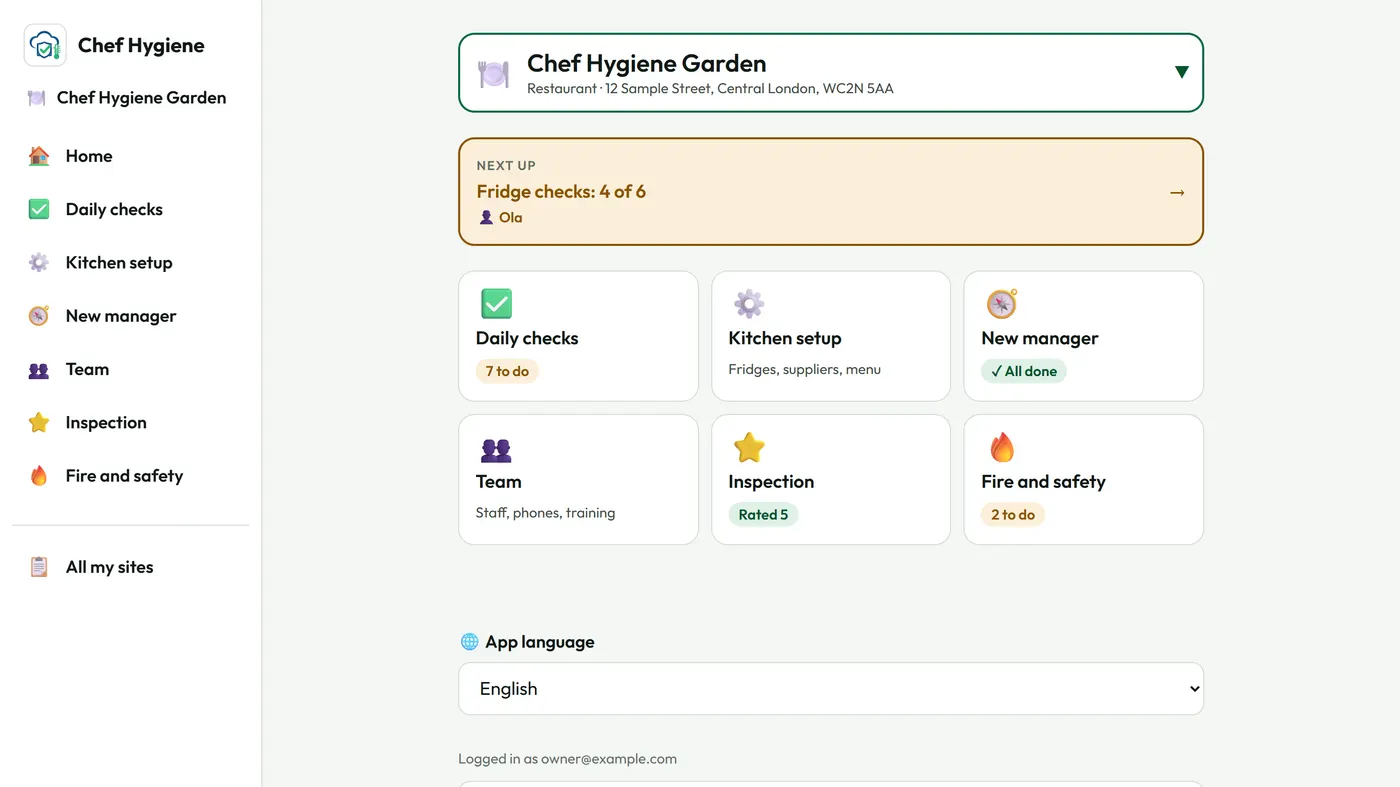
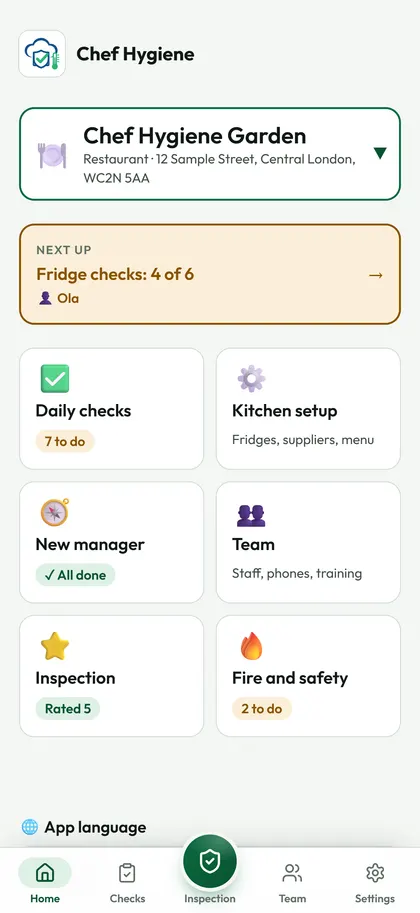
The app loads these rules for your kitchen, checks your records against them and keeps proof for the inspector.
Other countries
 United Kingdom
 Ireland
 Iceland
 United States
 Canada
 France
 Netherlands
 Belgium
 Portugal
 Germany
 Austria
 Poland
 Romania
 Italy
Italy Greece
 Denmark
 Switzerland
 Luxembourg
 Cyprus
 Malta
Malta Sweden
 Norway
 Finland
 Czechia
 Hungary
 Croatia
 Bulgaria
 Slovakia
 Slovenia
 Estonia
 Latvia
 Lithuania
 Liechtenstein
 San Marino
 Gibraltar
 Monaco
 Moldova
 Andorra
 Serbia
 Jersey
 Guernsey
 Isle of Man
 Türkiye
 Montenegro
 Bosnia & Herzegovina
 Kosovo
 Albania
 North Macedonia
 Ukraine