 Switzerland: for restaurants and takeaways
Ready for the food inspection. Every day.
In Switzerland the app follows the federal Food Act (LMG) and the hygiene ordinance (HyV) and the GVG restaurant guide approved by the BLV; the cantons inspect, and there is no national rating.
14 days free · one price per site · no contract
Switzerland: food hygiene rules
- Inspection body
- Cantonal food control (Kantonschemiker/in, Kantonales Laboratorium), supervised by the Federal Food Safety and Veterinary Office (BLV)
- Public rating
- No
- Languages in the app
- Deutsch, Français, Italiano, English
Your inspection
The 26 cantons inspect. Each has a cantonal chemist (Kantonschemiker/in) with food inspectors. The federal office BLV supervises the cantons and approves sector guides, but it does not inspect restaurants. The same federal rules apply in every canton.
Controls are risk-based and unannounced. A restaurant with its own kitchen gets a basic control at least every 2 years. After a visit the inspector gives a written result and can order repairs, ban rooms, equipment or a process, or close the business at once if health is in serious danger. Fees apply only after a formal finding (Beanstandung), a repeat fault or a follow-up visit, at most CHF 4,000 per inspection. Fines can reach CHF 40,000. You can object within 10 days (Einsprache) and appeal within 30 days (Beschwerde).
Hygiene rating
There is no national rating. Control reports and risk classes are not public (LMG Art. 24). Only canton Zug has an official quality certificate («sehr gut», «gut», «genügend», «ungenügend»), and showing it is voluntary.
“Law” is a binding rule. “Official guidance” is not law, but inspectors expect it. “Chef Hygiene default” is a value the app checks against where no rule gives a number.
Temperatures
- Official guidanceSwiss law sets no general fridge number: keep the cold chain unbroken (HyV Art. 24). The GVG guide says perishable food at 5°C at most, egg products at 4°C, and the maker’s own maximum comes first.
- LawFresh and thawed raw fish, and cooked chilled crustaceans and molluscs, must be at melting ice, 2°C at most (HyV Art. 44). Mince must be chilled to 2°C or frozen (HyV Art. 29 and 31).
- LawFrozen food must be at −18°C or colder. The surface must never be above −15°C (HyV Art. 25).
- Official guidanceGVG guide: cook and reheat to a core temperature of 70°C or more, held for at least 2 minutes. Pink meat is a known exception.
- Official guidanceGVG guide: keep hot food at a core temperature of 65°C or more, for 3 hours at most. Spot-check it and write it down. Law only says to use temperatures that prevent growth (HyV Art. 27).
- Official guidanceGVG guide: cool actively from 65°C to below 5°C within 90 minutes. The law says only “as fast as possible” (HyV Art. 27).
- Official guidanceGVG guide: a break in the cold chain should last 30 minutes at most. Chilled food that was offered unchilled is thrown away.
- Official guidanceGVG guide: thaw in the fridge, in a sealed bag under cold running water, or in a thawing device. Label the thaw date, use within 48 hours (delicate food 24 hours) and never refreeze.
- Official guidanceGVG guide: frying oil at 175°C at most, with polar compounds at 27 % at most.
Staff, training and health
- LawFood handlers must be supervised and instructed or trained for their job. Whoever runs the HACCP system must be trained in HACCP (HyV Art. 22). Federal law sets no certificate, hours or renewal.
- Official guidanceGVG guide: write down the training. In a small business, oral instruction plus a signed attendance list is enough.
- LawSeveral cantons ask the restaurant manager for a hospitality certificate (Wirtepatent). In 2018 this applied in BE, FR, GE, TI, VD, VS, AG, BL, BS, JU, SO, TG, AI, LU, NW, OW and SH. Check the rule of your canton.
- LawNobody with an acute foodborne illness may work with food. Carriers and people with infected wounds or skin lesions may work only with hygiene measures that rule out contamination. Staff must tell the responsible person at once (HyV Art. 21). Law and the GVG set no fixed time off and no medical certificate.
- LawIf several people are ill at once, report it to the canton (HyV Art. 21).
- Chef Hygiene defaultChef Hygiene advises 48 hours away from food work after sickness symptoms stop.
Allergens
- LawThe 14 allergens are the same as in the EU (LIV Annex 6). Loose food needs the same information as prepacked food (LGV Art. 39).
- LawYou may give allergen information orally only if a clearly visible written notice says so, and staff have the details in writing or an expert can answer at once (LIV Art. 5). A menu or poster also works.
- LawThe origin country of meat and fish must always be given in writing. A “may contain traces” notice is not needed for loose food (LGV Art. 39, LIV Art. 5).
- Official guidanceGVG guide: written allergen marking is voluntary. If you use codes, use the GVG numbering from 1 (gluten) to 14 (molluscs).
Fire safety checks
- LawElectrical installations in restaurants and small food places (under 1,200 m², up to 300 people) must be checked every 5 years by an independent control body. The grid operator writes to you 6 months before (NIV Annex 2.3.8–2.3.9).
- Official guidanceVKF fire protection rules, enforced by the cantons: check extinguishers yourself and service them as the maker says. Record delivery, refill and service dates. No national interval is set. Chef Hygiene suggests a service every 24 months.
- Official guidanceVKF rules for kitchens: keep extraction systems clean so there is no fire risk, and fit grease filters. No cleaning interval is set. Never heat oil or fat unattended. Keep no gas bottles in basements.
- Official guidanceVKF rules for emergency lights: check them at least twice a year, or yearly with a status display, and keep a control book (Kontrollbuch).
- Official guidanceSince 1 April 2026 no fireworks of any class are allowed in publicly accessible rooms such as restaurants and bars (VKF rule 26-15).
Records
- LawEvery food business must run a self-check (Selbstkontrolle): good hygiene practice, HACCP principles scaled to risk and size, traceability and documentation. A business with up to 9 staff may reduce the documentation (LGV Art. 85).
- Official guidanceGVG guide for small businesses: look at fridge and freezer thermometers daily and write them down weekly or when a value is out of range. Keep signed delivery notes with the temperature check, a cleaning plan, pest checks and proof of training.
- Official guidanceGVG guide: keep delivery documents for at least 1 year or until the next inspection. Traceability data must be kept until the food is likely eaten (LGV Art. 83).
Official sources
- BLV, Federal Food Safety and Veterinary Office (approved guides)
- Hygiene ordinance HyV (SR 817.024.1), Fedlex
- Cantonal chemists (kantonschemiker.ch)
- GastroSuisse, GVG restaurant guide
- VKF fire protection rules
Checked
This page is general information, not legal advice. Check with your local authority.
Switzerland: food hygiene guides
Set up Chef Hygiene
Create your account, set up a shared kitchen tablet, and put the app on your staff's phones, step by step.
Switzerland: food inspections
Who inspects your kitchen, how an inspection works and whether there is a public hygiene rating.
Switzerland: food temperature rules
The food temperatures your kitchen must keep, and the rules behind them.
Switzerland: allergens
What your kitchen must tell customers about allergens.
Switzerland: staff sickness and training
Training, food handler rules and when sick staff must stay away from food.
Switzerland: fire safety
Fire safety checks for your kitchen, and how often they are due.
Switzerland: records to keep
The records and registrations your kitchen must keep.
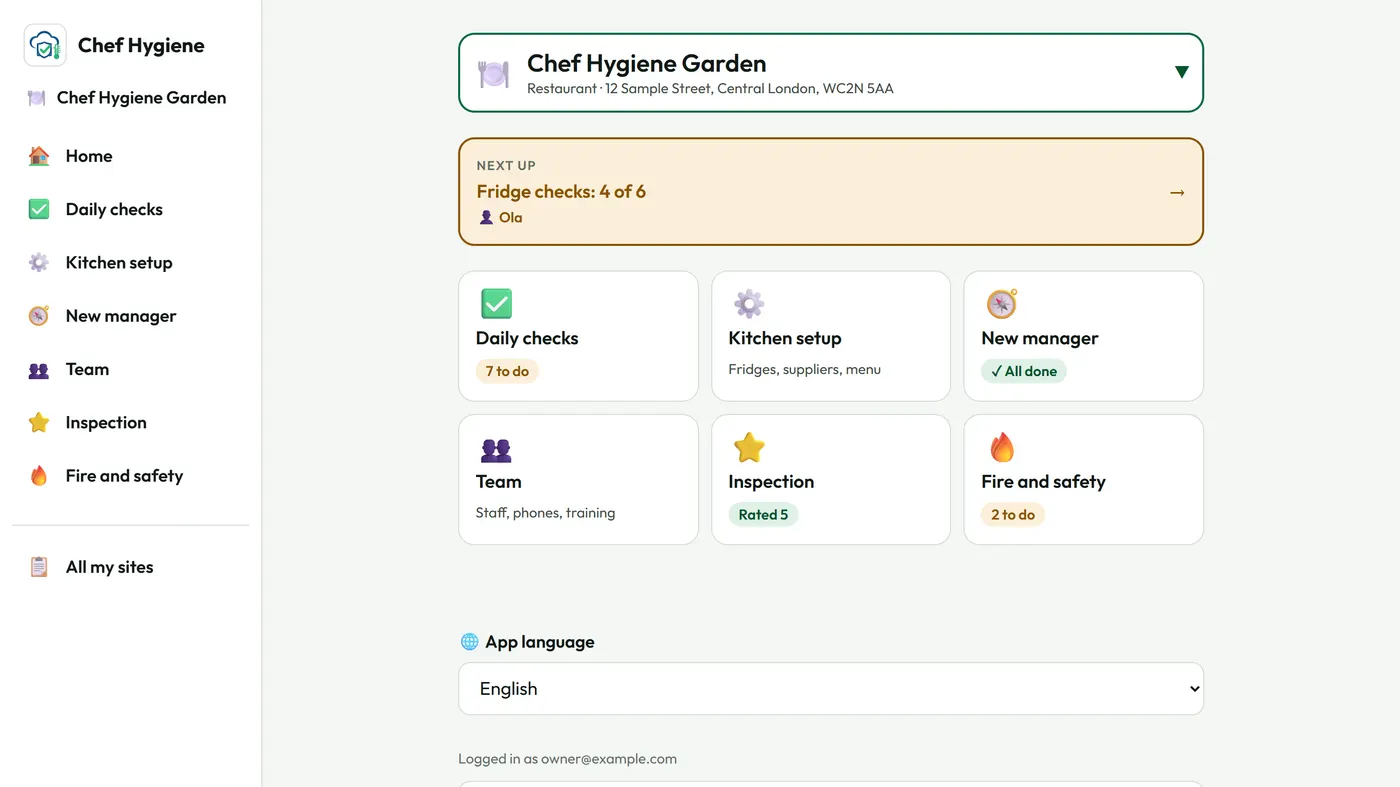
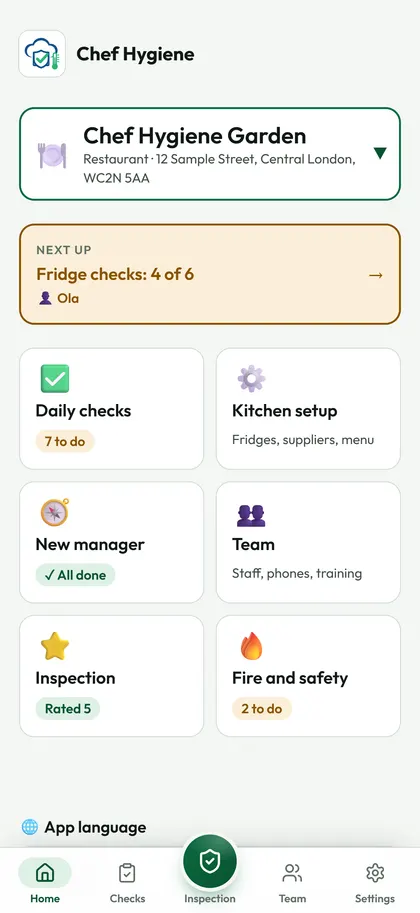
Switzerland: the Chef Hygiene app
The app loads these rules for your kitchen, checks your records against them and keeps proof for the inspector.
Other countries
 United Kingdom
 Ireland
 Iceland
 United States
 Canada
 France
 Spain
Spain Netherlands
 Belgium
 Portugal
 Germany
 Austria
 Poland
 Romania
 Italy
Italy Greece
 Denmark
 Luxembourg
 Cyprus
 Malta
Malta Sweden
 Norway
 Finland
 Czechia
 Hungary
 Croatia
 Bulgaria
 Slovakia
 Slovenia
 Estonia
 Latvia
 Lithuania
 Liechtenstein
 San Marino
 Gibraltar
 Monaco
 Moldova
 Andorra
 Serbia
 Jersey
 Guernsey
 Isle of Man
 Türkiye
 Montenegro
 Bosnia & Herzegovina
 Kosovo
 Albania
 North Macedonia
 Ukraine