 Ireland: for restaurants and takeaways
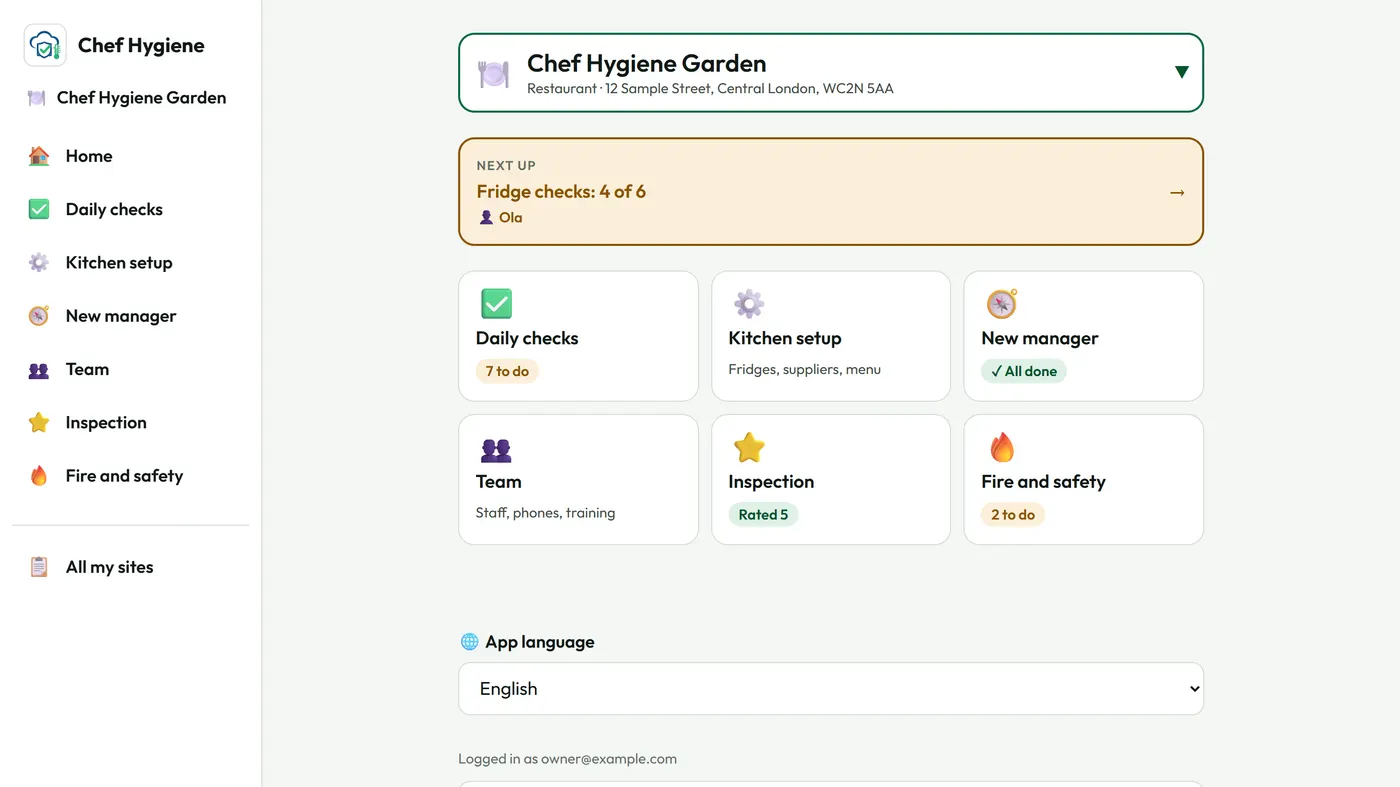
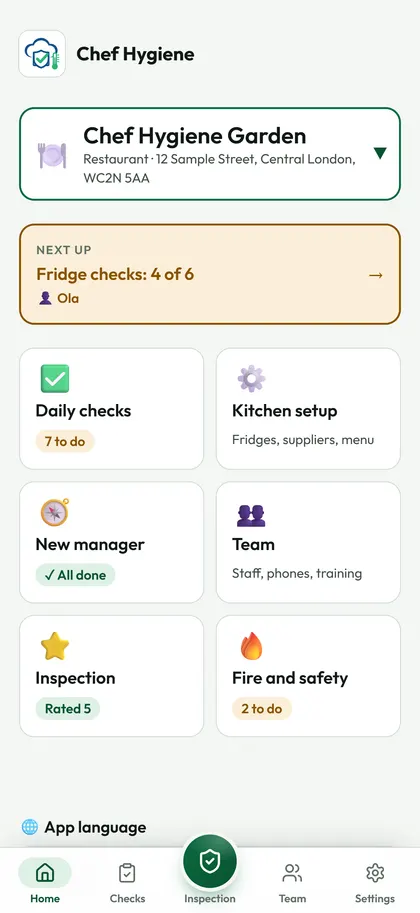
Ready for the food inspection. Every day.
In Ireland the app follows EU Regulation 852/2004 as set out in S.I. 369/2006, FSAI guidance and the FSAI Safe Catering Pack, and HSE Environmental Health Officers inspect.
14 days free · one price per site · no contract
Ireland: food hygiene rules
- Inspection body
- Food Safety Authority of Ireland (FSAI); restaurants and takeaways are inspected by the HSE National Environmental Health Service
- Public rating
- No
- Languages in the app
- English
Your inspection
The HSE National Environmental Health Service inspects restaurants, takeaways and similar premises. Its Environmental Health Officers (EHOs) work under service contracts with the FSAI, which is legally responsible for enforcing food law.
Inspections are usually not announced. An EHO can come at any reasonable time when you are open, look round, ask questions and check your records. An EHO can serve an Improvement Notice. The District Court can make an Improvement Order, and a Closure Order is for a grave and immediate danger to public health or non-compliance. A Prohibition Order stops the sale of a product or batch. A fixed payment notice of €250 applies to some offences, such as failing to register.
Hygiene rating
There is no public hygiene rating or sticker for restaurants. The FSAI publishes closure, improvement and prohibition orders, and its monthly press releases name the businesses.
“Law” is a binding rule. “Official guidance” is not law, but inspectors expect it. “Chef Hygiene default” is a value the app checks against where no rule gives a number.
Temperatures
- Official guidanceIrish law sets no numeric temperature limits. The numbers below come from FSAI guidance. The legal duty is not to break the cold chain (Regulation 852/2004, Annex II).
- Official guidanceChilled food: 0–5°C. The FSAI says to set fridges to 3–4°C.
- Official guidanceFrozen food: −18°C or colder. Ice cream in service areas: −12°C.
- Official guidanceCooking: 75°C at the core at once, or an equal time and temperature such as 70°C for 2 minutes.
- Official guidanceReheating: only once, to 70°C or more at the core.
- Official guidanceHot holding: above 63°C. Food not kept above 63°C must be used within 2 hours of cooking.
- Official guidanceCooling: put cooked food in the fridge within 2 hours. If it is above 10°C at 2½ hours, serve it at once or throw it away (FSAI Safe Catering).
- Official guidanceDeliveries: chilled food arrives below 5°C and frozen food at −18°C. Food you deliver to customers: chilled below 5°C, hot above 63°C.
- Official guidanceSafe Catering limits: prepared chilled food for at most 2 days, counting the day it is made as Day 0, and frozen food for at most 6 months. Probe thermometers should be accurate to ±0.5°C.
Staff, training and health
- LawStaff must be supervised and instructed or trained for their work. Whoever runs the HACCP system must be trained in HACCP (Regulation 852/2004, Annex II). No course or certificate is mandatory.
- LawAnyone with diarrhoea, infected wounds or skin infections must not handle food if there is a risk of contamination, and must report it at once.
- Official guidanceFSAI guidance: stay off work until 48 hours without symptoms. The FSAI’s Safe Catering form SC7 (Fitness to Work Assessment) can be used.
- Official guidanceFSAI Guide to Food Safety Skills: Level 1 within the first month, Level 2 within 3 to 12 months, and Level 3 for managers and supervisors. The FSAI has a free course, Food Safety and You.
- LawFood safety culture is a legal duty in Ireland (Regulation 852/2004, Annex II, Chapter XIa).
Allergens
- LawFor food that is not prepacked, written allergen information must be given where the food is presented, sold or supplied (S.I. 489/2014, Regulation 4). It must be easy to find before the sale, visible and legible.
- LawThe information must be in English, or in Irish and English, and clearly linked to the right food (S.I. 489/2014, Regulation 5). The FSAI says customers must not have to ask, and a general notice is not enough.
- Official guidancePhone and app orders: give the information before the order is completed and at delivery, in writing at least once.
- Official guidanceFood packed on site for direct sale counts as non-prepacked food, so the same written rule applies.
Fire safety checks
- LawFire Services Acts 1981 and 2003, section 18(2): the person having control of premises open to the public must take all reasonable measures against fire. They must provide fire safety measures and procedures and apply them at all times.
- LawA fire officer can require a fire safety assessment (section 18(6)). Under the Safety, Health and Welfare at Work Act 2005, every employer needs a written risk assessment. The HSA says fire risks are recorded in the Safety Statement and reviewed at least every year.
- Official guidanceOfficial guidance: the Fire Safety Guide for Building Owners and Operators (August 2023). Hold fire drills regularly.
- Chef Hygiene defaultGas work must be done by a Registered Gas Installer (RGI). Chef Hygiene checks gas appliances and pipes at least once a year.
Records
- LawA HACCP-based food safety system has been a legal requirement since 1998. The FSAI’s Safe Catering Pack is its catering system, and I.S. 340:2007 is a recognised voluntary guide.
- Official guidanceSafe Catering forms include SC1 Food Delivery Record, SC2 Fridge/Freezer/Chill Display Temperature Record, SC3 Cooking/Cooling/Reheating Record, SC4 Hot Holding/Display Temperature Record and SC6 Hygiene Training Record.
- Official guidanceReview the food safety plan every year and when operations change. Show it to an EHO on request. Keep pest contractor reports.
- LawThe law says only that records are kept for an appropriate period. Traceability records are kept until the food can reasonably be assumed to have been eaten. Caterers selling to the public only need to trace one step back.
Official sources
- FSAI: temperature control for caterers
- HSE: notify the HSE about starting a food business
- FSAI: enforcement orders
- S.I. 489/2014 (allergen information)
- FSAI: allergens
Checked
This page is general information, not legal advice. Check with your local authority.
Ireland: food hygiene guides
Set up Chef Hygiene
Create your account, set up a shared kitchen tablet, and put the app on your staff's phones, step by step.
Ireland: food inspections
Who inspects your kitchen, how an inspection works and whether there is a public hygiene rating.
Ireland: food temperature rules
The food temperatures your kitchen must keep, and the rules behind them.
Ireland: allergens
What your kitchen must tell customers about allergens.
Ireland: staff sickness and training
Training, food handler rules and when sick staff must stay away from food.
Ireland: fire safety
Fire safety checks for your kitchen, and how often they are due.
Ireland: records to keep
The records and registrations your kitchen must keep.
Ireland: the Chef Hygiene app
The app loads these rules for your kitchen, checks your records against them and keeps proof for the inspector.
Other countries
 United Kingdom
 Iceland
 United States
 Canada
 France
 Spain
Spain Netherlands
 Belgium
 Portugal
 Germany
 Austria
 Poland
 Romania
 Italy
Italy Greece
 Denmark
 Switzerland
 Luxembourg
 Cyprus
 Malta
Malta Sweden
 Norway
 Finland
 Czechia
 Hungary
 Croatia
 Bulgaria
 Slovakia
 Slovenia
 Estonia
 Latvia
 Lithuania
 Liechtenstein
 San Marino
 Gibraltar
 Monaco
 Moldova
 Andorra
 Serbia
 Jersey
 Guernsey
 Isle of Man
 Türkiye
 Montenegro
 Bosnia & Herzegovina
 Kosovo
 Albania
 North Macedonia
 Ukraine