 Finland: for restaurants and takeaways
Ready for the food inspection. Every day.
Chef Hygiene follows the Finnish Food Act (297/2021), the hygiene decree 318/2021 and the Finnish Food Authority’s guidance, and the municipality inspects and publishes the result in the Oiva scheme.
14 days free · one price per site · no contract
Finland: food hygiene rules
- Inspection body
- Municipal food control (kunnan elintarvikevalvonta), led by the Finnish Food Authority (Ruokavirasto)
- Public rating
- Yes
- Languages in the app
- Suomi, Svenska, English
Your inspection
The municipal food control inspects restaurants (Food Act 297/2021, § 27). The Regional State Administrative Agency guides and checks the municipalities. The Finnish Food Authority (Ruokavirasto) leads the work nationally. A restaurant is a registered food activity, and you must tell the municipality at least 4 weeks before you start.
Visits are mostly unannounced. How often depends on the risk: guidance gives a restaurant cooking from raw animal food 0.5 to 2 inspections a year by size. You pay a yearly base fee of EUR 150 plus the municipality’s hourly fee. After faults the inspector can order a correction, ban food or the activity, close a registered activity if an order is ignored, or set a conditional fine. A sanction fee of EUR 300 to 5,000 applies for example for no own-check, no registration or no traceability.
Hygiene rating
Yes: Oiva, the national scheme. Four grades: A Oivallinen (excellent), B Hyvä (good), C Korjattavaa (to be corrected) and D Huono (poor). The weakest item sets the result. The latest report must be shown at the entrance, on your website and where you sell food online, and results are public on oivahymy.fi.
“Law” is a binding rule. “Official guidance” is not law, but inspectors expect it. “Chef Hygiene default” is a value the app checks against where no rule gives a number.
Temperatures
- LawFridge: other perishable food, raw meat and cooked dishes at 6°C or colder. Minced meat 4°C. Fresh packed, cold-smoked and thawed raw fish and cooked shellfish at 0 to 3°C (decree 318/2021, § 23).
- LawFreezer: −18°C. A short rise to −15°C is allowed for food sold frozen (decree 818/2012, § 9). Food you freeze yourself should be used within 2 months (guidance).
- Official guidanceCooking: over 70°C in the centre, and over 75°C for poultry. Cook minced and cut meat right through. There is no legal figure.
- LawHot holding: 60°C or hotter, and put the food out once only (decree 318/2021, § 23).
- LawCooling: start at once and reach the storage temperature (6°C, mince 4°C, fish 3°C) within 4 hours (decree 318/2021, § 23).
- Official guidanceReheating: over 70°C throughout, and pass quickly through 6 to 60°C (guidance).
- LawCold display: up to 12°C for at most 4 hours, once only (decree 318/2021, § 23).
- LawDeliveries: the food keeps its own storage temperature, and mixed chilled loads must be 6°C or colder. Food sent to customers must be chilled at 6°C or colder, or hot at 60°C or more.
- LawRaw fish for eating raw: freeze at −20°C for 24 hours or −35°C for 15 hours, unless exempt (EU Regulation 853/2004).
Staff, training and health
- LawHygiene passport (hygieniapassi): needed by anyone who handles unpackaged perishable food, after 3 months of such work. Owners, trainees and volunteers too (Food Act, § 19).
- LawThe passport test has 40 true or false statements, and you pass with 34. It never expires. The employer must see the original and keep a record.
- LawSalmonella statement (terveydentilan selvitys): before work, staff who handle unpackaged food served unheated, or handled after heating, need a reliable statement of no salmonella (Communicable Diseases Act 1227/2016, § 56). It is a free interview by occupational or health-centre staff.
- LawStaff with an infection that food can carry, infected wounds or diarrhoea must not handle food and must tell the employer at once (EU Regulation 852/2004). After salmonella-related cases, THL advises 2 symptom-free days.
Allergens
- LawThe 14 EU allergens must be given at the point of sale (decree 834/2014, §§ 6 and 8). The information is written, or oral if a visible notice says staff will tell you.
- LawIf you give the information orally, you must also keep it in writing or electronically for staff and inspectors. No notice is needed if the guest’s allergies were recorded in advance.
- LawAt a serving place the dish name and the country of origin of meat used must always be in writing. Information is given at least in Finnish or Swedish.
Fire safety checks
- LawHand fire extinguishers: an inspection every 24 months (every 12 months if damp, frosty or with vibration), by a registered company. Service at least every 10 years (Act 191/2024).
- LawA required fire alarm or automatic extinguishing system: a periodic inspection every 36 months (Act 191/2024, § 16).
- LawRescue plan: required for a restaurant with more than 50 customer seats. Keep it up to date.
- Official guidanceGrease ducts: clean about every 12 months, and filters weekly or monthly (rescue services’ guidance).
- LawElectrics: a periodic inspection every 10 years when the main fuses are over 35 A (Tukes).
Records
- LawYour own-check (omavalvonta) must find and control hazards, and you must record the results (Food Act, § 15; EU Regulation 852/2004, article 5). No own-check can bring a sanction fee.
- LawKeep own-check records at least 1 year after the use-by or best-before date, or 1 year after handling if the food has no date (decree 318/2021, § 22).
- LawKeep traceability data at least 1 year from sending or receiving the food.
Official sources
- Finnish Food Authority (Ruokavirasto)
- Oiva results (oivahymy.fi)
- Food Act 297/2021 (Finlex)
- Hygiene decree 318/2021 (Finlex)
- Food information decree 834/2014 (Finlex)
Checked
This page is general information, not legal advice. Check with your local authority.
Finland: food hygiene guides
Set up Chef Hygiene
Create your account, set up a shared kitchen tablet, and put the app on your staff's phones, step by step.
Finland: food inspections
Who inspects your kitchen, how an inspection works and whether there is a public hygiene rating.
Finland: food temperature rules
The food temperatures your kitchen must keep, and the rules behind them.
Finland: allergens
What your kitchen must tell customers about allergens.
Finland: staff sickness and training
Training, food handler rules and when sick staff must stay away from food.
Finland: fire safety
Fire safety checks for your kitchen, and how often they are due.
Finland: records to keep
The records and registrations your kitchen must keep.
Finland: the Chef Hygiene app
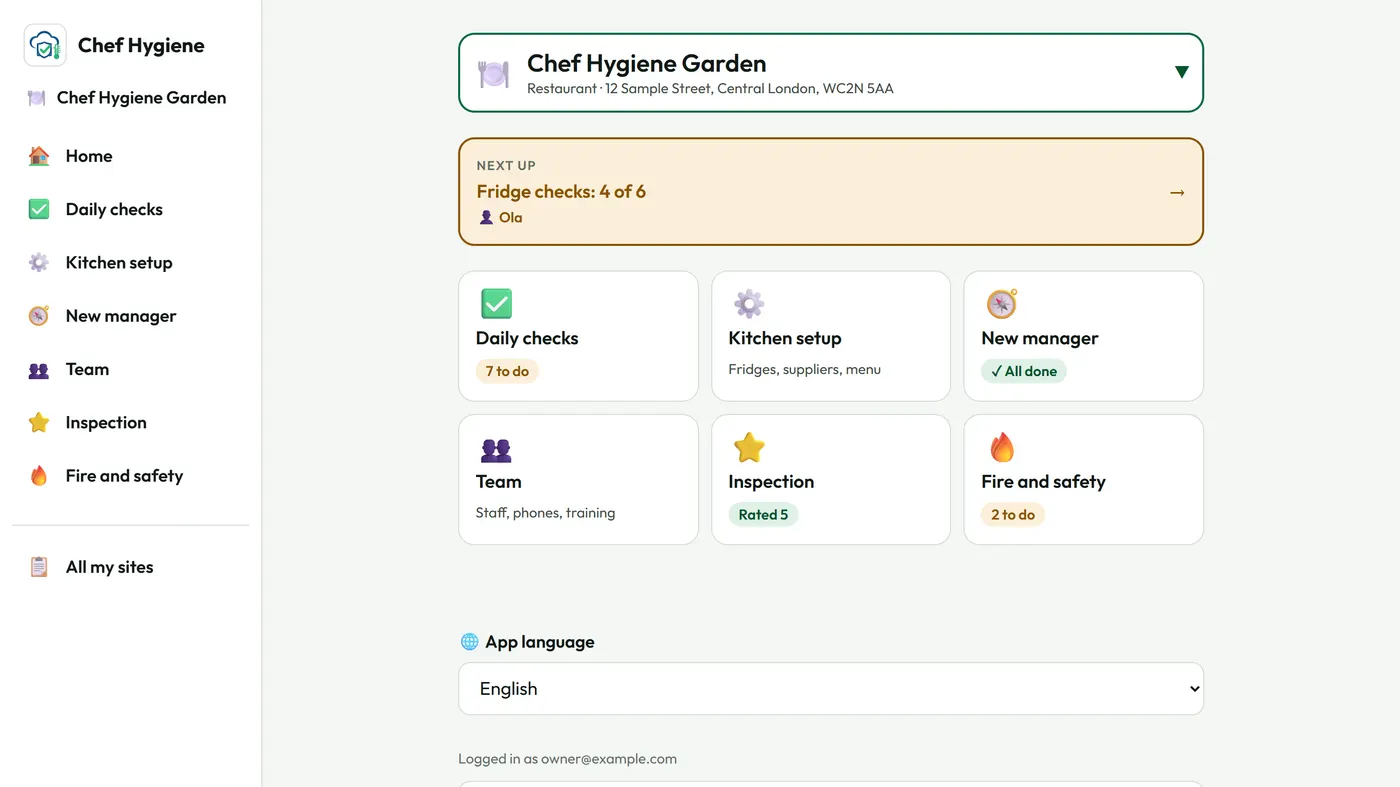
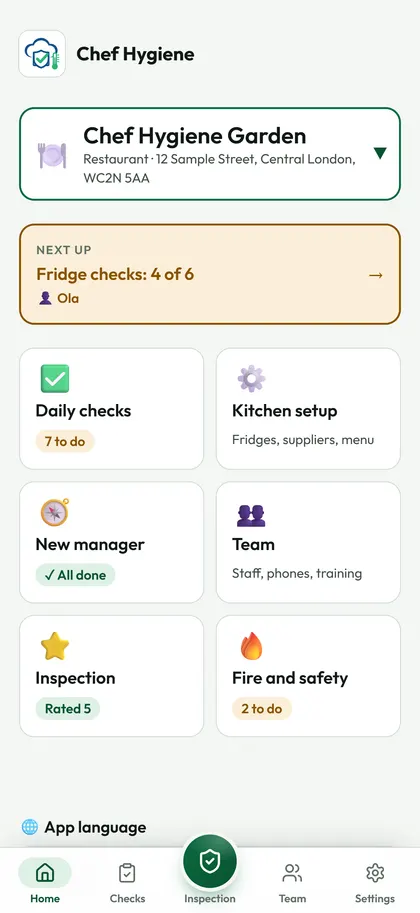
The app loads these rules for your kitchen, checks your records against them and keeps proof for the inspector.
Other countries
 United Kingdom
 Ireland
 Iceland
 United States
 Canada
 France
 Spain
Spain Netherlands
 Belgium
 Portugal
 Germany
 Austria
 Poland
 Romania
 Italy
Italy Greece
 Denmark
 Switzerland
 Luxembourg
 Cyprus
 Malta
Malta Sweden
 Norway
 Czechia
 Hungary
 Croatia
 Bulgaria
 Slovakia
 Slovenia
 Estonia
 Latvia
 Lithuania
 Liechtenstein
 San Marino
 Gibraltar
 Monaco
 Moldova
 Andorra
 Serbia
 Jersey
 Guernsey
 Isle of Man
 Türkiye
 Montenegro
 Bosnia & Herzegovina
 Kosovo
 Albania
 North Macedonia
 Ukraine