 Portugal: for restaurants and takeaways
Ready for the food inspection. Every day.
In Portugal, Chef Hygiene follows EU Regulation 852/2004, Decreto-Lei 113/2006, ASAE’s official guidance and the AHRESP code of good practice; ASAE inspects on the mainland, IRAE in the Azores and ARAE in Madeira.
14 days free · one price per site · no contract
Portugal: food hygiene rules
- Inspection body
- Food and Economic Safety Authority (Autoridade de Segurança Alimentar e Económica, ASAE)
- Public rating
- No
- Languages in the app
- Português, English
Your inspection
ASAE inspects restaurants and food businesses on the mainland. In the Azores the regional inspector is IRAE (Inspeção Regional das Atividades Económicas). In Madeira it is ARAE (Autoridade Regional das Atividades Económicas). DGAV is the national authority for food information.
Inspections are risk-based. Hygiene breaches are serious economic offences (contraordenações económicas graves) under Decreto-Lei 9/2021 and bring a fine (coima). Serious breaches can lead to closure (encerramento).
Hygiene rating
No. Portugal has no public hygiene rating or sticker. ASAE publishes press releases and yearly results of its operations, not a score for each restaurant.
“Law” is a binding rule. “Official guidance” is not law, but inspectors expect it. “Chef Hygiene default” is a value the app checks against where no rule gives a number.
Temperatures
- Official guidanceChilled food: 0 to 5°C (ASAE guidance). The AHRESP code says 0 to 4°C. A product’s label or its own law comes first, for example for minced meat and fresh fish. Chef Hygiene aims for 4°C.
- Official guidanceFrozen food: −18°C or colder (ASAE guidance).
- Official guidanceHot food ready to serve: 60°C or hotter (ASAE). The AHRESP code says 65°C or hotter, and cooked food below 65°C for more than 2 hours is thrown away. Chef Hygiene checks against 65°C.
- Official guidanceCooling: ASAE says as fast as possible, using a blast chiller, small portions and shallow trays. The AHRESP code says down to 5°C within 2 hours.
- Official guidanceReheating: the AHRESP code says 65°C in the centre, once only. Portuguese law and ASAE give no reheating number.
- Chef Hygiene defaultPortuguese law sets no cooking temperature. The AHRESP code says 65°C in the centre. Chef Hygiene checks against 75°C, or 70°C for 2 minutes.
- Official guidanceThaw in the fridge, in thawing equipment, in the microwave just before cooking, or during cooking. Never thaw at room temperature (ASAE).
- LawFrying oil: never above 180°C, and oil with more than 25% polar compounds may not be used (Portaria 1135/95). ASAE advises frying at 160 to 175°C.
Staff, training and health
- LawPortuguese law sets no food hygiene certificate, minimum hours or renewal. Training must suit the job and be updated when needed (EU Regulation 852/2004, Annex II, Chapter XII).
- Official guidanceManagers responsible for the HACCP procedures need adequate training (ASAE).
- LawNobody with a disease carried by food, infected wounds, skin infections, sores or diarrhoea may handle food. They must tell the manager at once (Regulation 852/2004, Annex II, Chapter VIII).
Allergens
- LawThe 14 EU allergens must be declared: gluten cereals, crustaceans, eggs, fish, peanuts, soya, milk, nuts, celery, mustard, sesame, sulphites, lupin and molluscs (Regulation 1169/2011).
- LawIn restaurants, allergen information must be available on a medium the customer can easily take in, such as a menu, board, sheet or screen (Decreto-Lei 26/2016, art. 4). Spoken-only information is not enough on this reading.
- LawFood packed in the restaurant for direct sale carries an allergen label (art. 6). For delivery apps and phone orders, give allergens before the order is completed and again at delivery (art. 8).
- Official guidanceCompulsory food information, including allergens, must be in Portuguese. Other languages may be added.
Fire safety checks
- LawGas installations in restaurants are inspected every 3 years by a recognised inspection body (Decreto-Lei 97/2017, art. 21). This does not cover an appliance fed straight from a gas bottle.
- LawElectrical installations are inspected every 5 years, but only for installations listed in the law (Decreto-Lei 96/2017, art. 19). One example is commercial premises with a supply over 41.4 kVA.
- LawExtinguishers must be maintained by a company registered with ANEPC and certified to NP 4413. A yearly service is the usual practice.
- LawKitchens over 20 kW need a fire blanket and an extinguisher of at least 25F where oil or fat is used. They also need a manual gas and power cut-off at the main door and posted safety instructions (RT-SCIE).
- LawKeep the fire safety records (registos de segurança) for at least 10 years (RT-SCIE, art. 201).
Records
- LawRestaurants need own checks (autocontrolo) based on HACCP principles, with the flexibility Regulation 852/2004 gives small businesses (Decreto-Lei 113/2006).
- Official guidanceASAE says records can cover temperatures, cleaning, goods received, pest control, training, maintenance, corrective actions and allergen management. Paper or digital is fine.
- Official guidanceThe AHRESP code says to record fridge and freezer temperatures at least once a day. Food law sets no fixed record period.
- LawEvery restaurant must have the paper complaints book and the electronic one (livroreclamacoes.pt), with a sign in a visible place. Keep closed books for at least 3 years (Decreto-Lei 156/2005).
Official sources
- ASAE, official site (FAQ Área Alimentar)
- DGAV, national food and veterinary authority
- Decreto-Lei 113/2006, consolidated (Diário da República)
- Decreto-Lei 97/2017 on gas installations
- Complaints book (livro de reclamações), ASAE
Checked
This page is general information, not legal advice. Check with your local authority.
Portugal: food hygiene guides
Set up Chef Hygiene
Create your account, set up a shared kitchen tablet, and put the app on your staff's phones, step by step.
Portugal: food inspections
Who inspects your kitchen, how an inspection works and whether there is a public hygiene rating.
Portugal: food temperature rules
The food temperatures your kitchen must keep, and the rules behind them.
Portugal: allergens
What your kitchen must tell customers about allergens.
Portugal: staff sickness and training
Training, food handler rules and when sick staff must stay away from food.
Portugal: fire safety
Fire safety checks for your kitchen, and how often they are due.
Portugal: records to keep
The records and registrations your kitchen must keep.
Portugal: the Chef Hygiene app
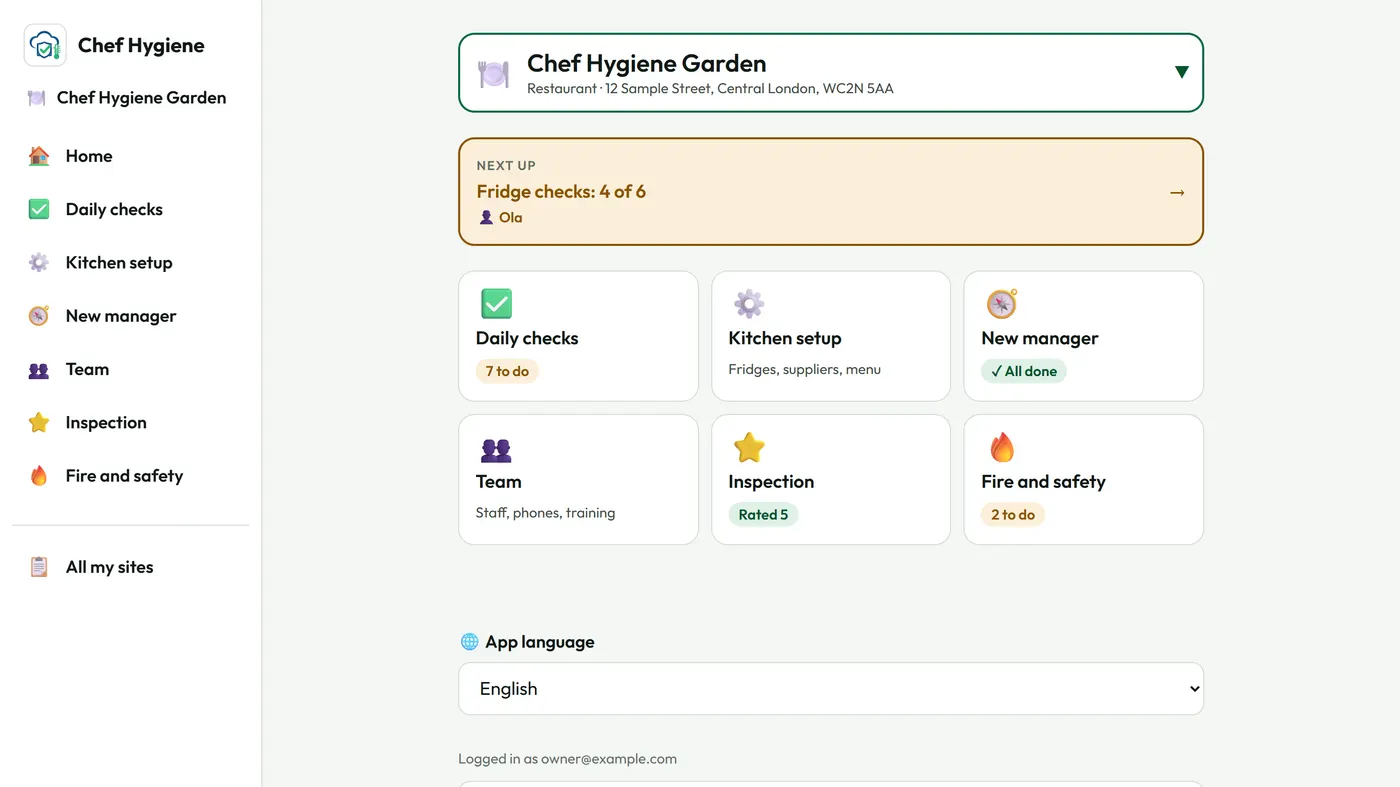
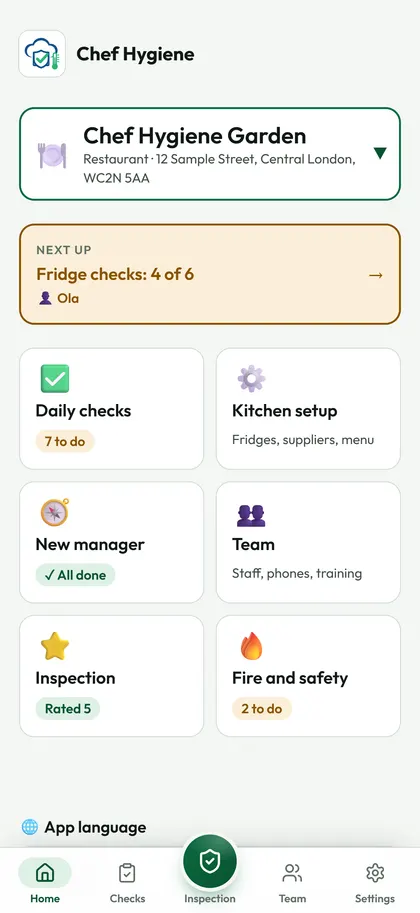
The app loads these rules for your kitchen, checks your records against them and keeps proof for the inspector.
Other countries
 United Kingdom
 Ireland
 Iceland
 United States
 Canada
 France
 Spain
Spain Netherlands
 Belgium
 Germany
 Austria
 Poland
 Romania
 Italy
Italy Greece
 Denmark
 Switzerland
 Luxembourg
 Cyprus
 Malta
Malta Sweden
 Norway
 Finland
 Czechia
 Hungary
 Croatia
 Bulgaria
 Slovakia
 Slovenia
 Estonia
 Latvia
 Lithuania
 Liechtenstein
 San Marino
 Gibraltar
 Monaco
 Moldova
 Andorra
 Serbia
 Jersey
 Guernsey
 Isle of Man
 Türkiye
 Montenegro
 Bosnia & Herzegovina
 Kosovo
 Albania
 North Macedonia
 Ukraine