 Greece: for restaurants and takeaways
Ready for the food inspection. Every day.
In Greece the app follows the Ministry of Health ordinance Υ.Δ. 47829/2017 and the EFET hygiene guides; EFET and the regional public health services inspect, and there is no public rating.
14 days free · one price per site · no contract
Greece: food hygiene rules
- Inspection body
- Hellenic Food Authority (Ενιαίος Φορέας Ελέγχου Τροφίμων, EFET)
- Public rating
- No
- Languages in the app
- Ελληνικά, English
Your inspection
EFET, the Hellenic Food Authority (Ενιαίος Φορέας Ελέγχου Τροφίμων), works under the Ministry of Rural Development and Food. It checks raw materials, food preparation, premises, equipment, staff hygiene and the HACCP-based system. The regional public health services (υγειονομικές υπηρεσίες) also inspect restaurants under the Ministry of Health ordinance. The municipality (Δήμος) takes the notification to open a food business.
Inspections are risk-based: high-risk businesses come first. They can be unannounced or follow a complaint. The inspector suggests improvements and sets a date for a re-check. A risk to health or repeated non-compliance brings sanctions. The municipality closes a business on the health service’s proposal, and EFET’s Board ratifies EFET fines.
Hygiene rating
Greece has no public hygiene rating, score or sticker, and nothing has to be shown at the door. EFET publishes yearly statistics of its controls, not results for single restaurants.
“Law” is a binding rule. “Official guidance” is not law, but inspectors expect it. “Chef Hygiene default” is a value the app checks against where no rule gives a number.
Temperatures
- LawCooked food kept cold in retail self-service must be below 4°C (Υ.Δ. 47829/2017, art. 13). The ordinance sets no fridge number for restaurants.
- Official guidanceEFET guidance: fridges at 1–5°C and chilled food at 5°C or colder. Chef Hygiene aims for 4°C and warns above 5°C. A colder label or product rule comes first.
- Official guidanceEFET guidance: freezers at −18°C or colder. Never refreeze thawed food.
- Official guidanceCook to 75°C in the centre, or 70°C for 2 minutes (EFET guidance).
- LawHot holding equipment must keep the inside of the food above 60°C (Υ.Δ. 47829/2017, art. 11 and 13).
- Official guidanceEFET guidance for food between 5°C and 60°C: up to 2 hours, serve or chill it. From 2 to 4 hours, serve it and never chill it. Over 4 hours, throw it away. This is allowed once only, during service.
- Official guidanceEFET guidance for cooling cooked food: from 60°C to 21°C within 2 hours, then to 5°C within 2 more hours. Another table in the same guide says 60°C to 10°C within 2 hours.
- Official guidanceEFET guidance for reheating: heat chilled food to over 75°C in the centre, once only, and serve it at once.
- Official guidanceEFET guidance for deliveries: meat, mince, poultry and fish at 5°C or colder; eggs and live shellfish at 7°C or colder; frozen food at −18°C. Refuse food carried in the wrong conditions.
Staff, training and health
- LawEvery food handler and cleaner needs EFET’s level 1 training certificate: a course of at least 8 hours and an EFET online exam (ΥΑ 110581/2025). The certificate is valid for 5 years. Old certificates stay valid until 6 May 2030.
- LawStaff with a recognised degree that includes food hygiene are exempt from this training (ΥΑ 110581/2025).
- LawEvery worker needs a health certificate (πιστοποιητικό υγείας): a doctor’s exam and a chest X-ray. Food handlers also need stool tests. It is valid for 5 years (Υ.Δ. 35797/2012).
- LawStaff must tell their supervisor about stomach or gut illness, sore throat, cough, or discharge from the nose or eyes. They must stay out of food areas and come back only with a doctor’s note (Υ.Δ. 47829/2017, art. 8).
- LawWounds, burns and skin infections must be covered with a brightly coloured waterproof dressing (Υ.Δ. 47829/2017, art. 8).
- LawA restaurant needs a hand basin with hot and cold water, liquid soap and disposable towels, colour-coded knives and boards, and pedal bins (Υ.Δ. 47829/2017, art. 14).
Allergens
- LawGive information on the 14 EU allergens for food sold loose or served (Regulation 1169/2011, art. 44).
- Official guidanceEFET circular 20303/2014: give the information in writing (menu, list or signs) or by speaking. The information must be in Greek. Other languages may be added.
- Official guidanceEFET circular 20303/2014: spoken information is allowed only with all three of these. A visible sign says where to find the information or asks customers to ask staff. A paper or screen copy is on site. Trained staff give it free, before the sale.
- Official guidanceEFET circular 20303/2014: for phone and online orders, tell the customer before ordering that the information is available. Update it at once when a recipe changes.
Fire safety checks
- LawFire extinguishers and fire equipment must be serviced at least once a year by a qualified technician, who signs the maintenance book (Fire Ordinance 12/2012). Keep the book on site.
- LawA fire protection certificate (πιστοποιητικό ενεργητικής πυροπροστασίας) is needed only if the customer area is for over 150 people, LPG is used in customer areas, the shop is over 1,000 m², or over 200 kg of LPG cylinders are stored. It is valid for 5 years. Other restaurants keep a fire safety study and the maintenance book on site (Fire Service circular 48689/2025).
- LawThe electrical installation must be re-inspected by a licensed electrician at least every 5 years for up to 50 people, and every 2 years for over 50 people (ΥΑ 101195/2021). Check again within 30 days of a new owner, and after panel work, an electric shock, a flood, a fire or an earthquake.
- LawThe extraction hood must be kept clean and maintained without fail, with proof of cleaning in the business file. The ordinance sets no cleaning interval (Υ.Δ. 47829/2017).
- Chef Hygiene defaultChef Hygiene suggests a yearly check by a licensed gas installer. No legal interval for restaurant gas installations was found.
Records
- LawA restaurant needs HACCP-based procedures and a named hygiene person (Υ.Δ. 47829/2017, art. 5).
- LawKeep a temperature file for fridges, freezers, hot cabinets and cooking (Υ.Δ. 47829/2017, art. 6). The ordinance sets no daily count; Chef Hygiene asks for checks twice a day.
- LawKeep five more files: staff, health and training certificates; water; cleaning and disinfection; suppliers and traceability; pest control with a contract with a licensed pest control company, a map of bait stations and treatment records (Υ.Δ. 47829/2017, art. 6).
Official sources
- EFET, Hellenic Food Authority
- Υ.Δ. 47829/2017, health rules for food businesses
- EFET training for food business staff
- EFET allergen circular 20303/2014
- Ministry of Health
Checked
This page is general information, not legal advice. Check with your local authority.
Greece: food hygiene guides
Set up Chef Hygiene
Create your account, set up a shared kitchen tablet, and put the app on your staff's phones, step by step.
Greece: food inspections
Who inspects your kitchen, how an inspection works and whether there is a public hygiene rating.
Greece: food temperature rules
The food temperatures your kitchen must keep, and the rules behind them.
Greece: allergens
What your kitchen must tell customers about allergens.
Greece: staff sickness and training
Training, food handler rules and when sick staff must stay away from food.
Greece: fire safety
Fire safety checks for your kitchen, and how often they are due.
Greece: records to keep
The records and registrations your kitchen must keep.
Greece: the Chef Hygiene app
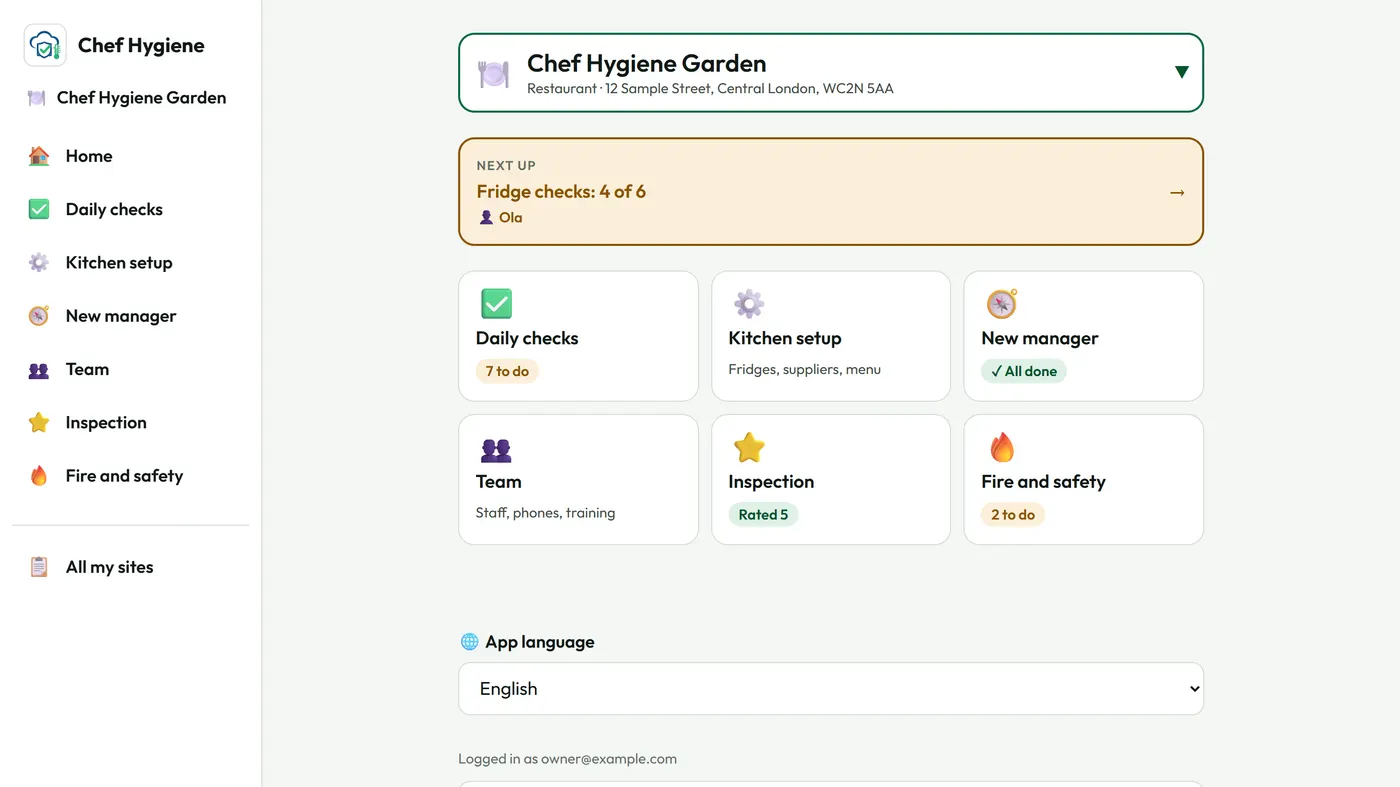
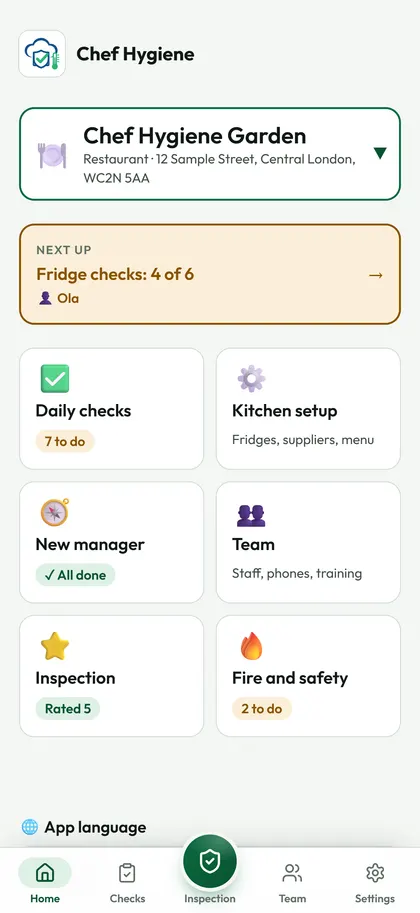
The app loads these rules for your kitchen, checks your records against them and keeps proof for the inspector.
Other countries
 United Kingdom
 Ireland
 Iceland
 United States
 Canada
 France
 Spain
Spain Netherlands
 Belgium
 Portugal
 Germany
 Austria
 Poland
 Romania
 Italy
Italy Denmark
 Switzerland
 Luxembourg
 Cyprus
 Malta
Malta Sweden
 Norway
 Finland
 Czechia
 Hungary
 Croatia
 Bulgaria
 Slovakia
 Slovenia
 Estonia
 Latvia
 Lithuania
 Liechtenstein
 San Marino
 Gibraltar
 Monaco
 Moldova
 Andorra
 Serbia
 Jersey
 Guernsey
 Isle of Man
 Türkiye
 Montenegro
 Bosnia & Herzegovina
 Kosovo
 Albania
 North Macedonia
 Ukraine