 Oostenrijk: voor restaurants en afhaalrestaurants
Klaar voor de voedselinspectie. Elke dag.
In Austria the app follows the food law (LMSVG), the allergen information regulation, EU Regulation 852/2004 and the health ministry’s hygiene guideline for restaurants; your federal state’s food control inspects.
14 dagen gratis · één prijs per locatie · geen contract
Oostenrijk: regels voor voedselhygiëne
De regels op deze pagina zijn voorlopig in het Engels. Ze zullen in uw taal worden vertaald.
- Inspectie-instantie
- Food control of the federal state (Lebensmittelaufsicht); in Vienna the Market Office MA 59 (Marktamt)
- Publieke beoordeling
- Nee
- Talen in de app
- Deutsch, English
Uw inspectie
Food control is the task of the governor (Landeshauptmann) of each of the 9 federal states. The Land’s trained food inspectors (Lebensmittelaufsicht) do the visits; in Vienna this is the Market Office MA 59. The agency AGES tests official samples.
Controls are based on risk, under a 3-year national control plan. After a visit the inspector can ask in writing for faults to be fixed by a deadline, or issue a formal order. Orders can go as far as closing all or part of the business. Fines are up to €35,000, and up to €70,000 for repeat cases.
Hygiënebeoordeling
Austria has no public hygiene rating or sticker. Results are not published for each business, and there is nothing to display at the door.
“Wet” is een bindende regel. “Officiële richtlijnen” zijn geen wet, maar inspecteurs verwachten ze wel. “Chef Hygiene standaardwaarde” is een waarde die de app controleert wanneer er geen regel is die een getal voorschrijft.
Temperaturen
- Officiële richtlijnenChilled food: 0–4°C, with a tolerance up to 6°C. Chef Hygiene aims for 4°C and flags readings above 6°C. No Austrian law sets restaurant temperatures; this is the ministry’s guideline (Beilage 1b).
- Officiële richtlijnenRecommended maximum for restaurants: poultry, rabbit and raw mince 4°C, other meat 7°C, offal 3°C. Raw fish is kept at melting-ice temperature. A fridge with mixed food is set to the lowest temperature needed.
- Officiële richtlijnenFrozen food: −18°C, with a tolerance up to −15°C.
- Officiële richtlijnenHot food: as hot as possible, in any case above 70°C. A short drop is tolerated if the food stays safe. The staff leaflet says at least 75°C for hot food on offer.
- Officiële richtlijnenCooling: cool food that is not eaten at once quickly to 0–4°C (6°C at most), if possible within 2 hours, and keep it there.
- Officiële richtlijnenReheating: a core temperature of at least 75°C for several minutes.
- Officiële richtlijnenCooking: hot dishes with raw egg reach 75°C in the core. Mince, poultry and fish must be well heated through; the guideline gives no number.
- Officiële richtlijnenSalads on a buffet for more than 2 hours must be kept chilled.
- Officiële richtlijnenDeliveries: refuse frozen food above −15°C, and chilled food more than 3°C above the product’s own set temperature. Chef Hygiene uses 7°C as one number for chilled deliveries.
Personeel, opleiding en gezondheid
- WetFood workers must be supervised and trained in food hygiene for their work (EU Regulation 852/2004). Austrian law sets no certificate, hours or renewal.
- Officiële richtlijnenThe ministry’s guideline asks for training at least once a year, at hiring and when tasks change, in a language the worker understands. Record place, date, topic, length, trainer and signatures, and keep the record for 3 years.
- Officiële richtlijnenHealth instruction (Belehrung), oral and written with a signed form, at the start and once a year.
- Officiële richtlijnenSick staff: no food work with diarrhoea or vomiting, infected wounds, or skin disease that cannot be covered. Stay away at least 48 hours after symptoms end, unless an infection is ruled out. Disinfect hands after every toilet visit for 3 weeks. Staff must tell you at once.
- WetStaff who give allergen information by word of mouth must be trained, and the training must be documented (Allergeninformationsverordnung § 3).
Allergenen
- WetThe 14 EU allergens: cereals with gluten, crustaceans, eggs, fish, peanuts, soybeans, milk, tree nuts, celery, mustard, sesame, sulphites, lupin and molluscs.
- WetFor food that is not prepacked, give the allergen information in writing without being asked. Or put up a clearly visible notice that staff give it by word of mouth on request (Allergeninformationsverordnung § 3).
- WetInformation by word of mouth must come from trained staff and always be based on written records, such as recipes and supplier labels (§§ 3 and 4).
- Officiële richtlijnenThe official Austrian Food Code (Codex A5) has letter codes A to R for the 14 allergens. You may use them only with a legend headed “Allergeninformation gemäß Codex-Empfehlung”.
Brandveiligheidscontroles
- WetFire extinguishers and fixed extinguishing systems are checked at least every second calendar year, and no more than 27 months apart, by a competent person. Keep the record for 3 years or use a sticker with the test date (AStV § 13).
- WetEmergency lighting, alarm devices, ventilation and air-conditioning systems and fire alarm systems are checked every year, no more than 15 months apart. Emergency lights and escape signs are checked by eye every month (AStV § 13).
- WetThe electrical installation is tested by an electrician at most every 5 years. The labour inspectorate can set 3 years for wet or hot areas. The RCD test button is pressed at least every 6 months unless the maker says otherwise (ESV 2012).
- WetGas checks are set by each federal state’s own gas law, with no national interval. Vienna and Styria set none; others range from 2 to 15 years. A permitted business plant is self-checked every 5 or 6 years (GewO § 82b).
- WetA fire safety book, fire safety rules and yearly fire drills are required only where the authority has ordered a fire safety officer (AStV §§ 43, 45).
Records
- WetYou need own checks based on HACCP principles (EU Regulation 852/2004). The ministry’s guideline for restaurants says normal restaurant cooking needs no critical control points if good hygiene practice controls the hazards.
- Officiële richtlijnenCheck fridge and freezer temperatures every working day, if possible at the start of work. Write down faults and what you did, and keep that record for 2 months past the food’s shelf life, at least 1 year.
- Officiële richtlijnenKeep training records for 3 years. Document pest checks at least every 3 months. Review the HACCP system every year, and at the latest every 2 years.
- Officiële richtlijnenKeep a cleaning plan, with a deep clean at least once a year, and goods-in checks of chilled and frozen deliveries.
Officiële bronnen
- Health ministry: hygiene guidelines and Food Code (verbrauchergesundheit.gv.at)
- AGES: food safety, control plan, product warnings
- RIS: Austrian federal and state laws
- Vienna food control (MA 59)
- Labour Inspectorate (workplace safety)
Checked
Deze pagina bevat algemene informatie en is geen juridisch advies. Neem contact op met uw lokale overheid.
Oostenrijk: gidsen voor voedselhygiëne
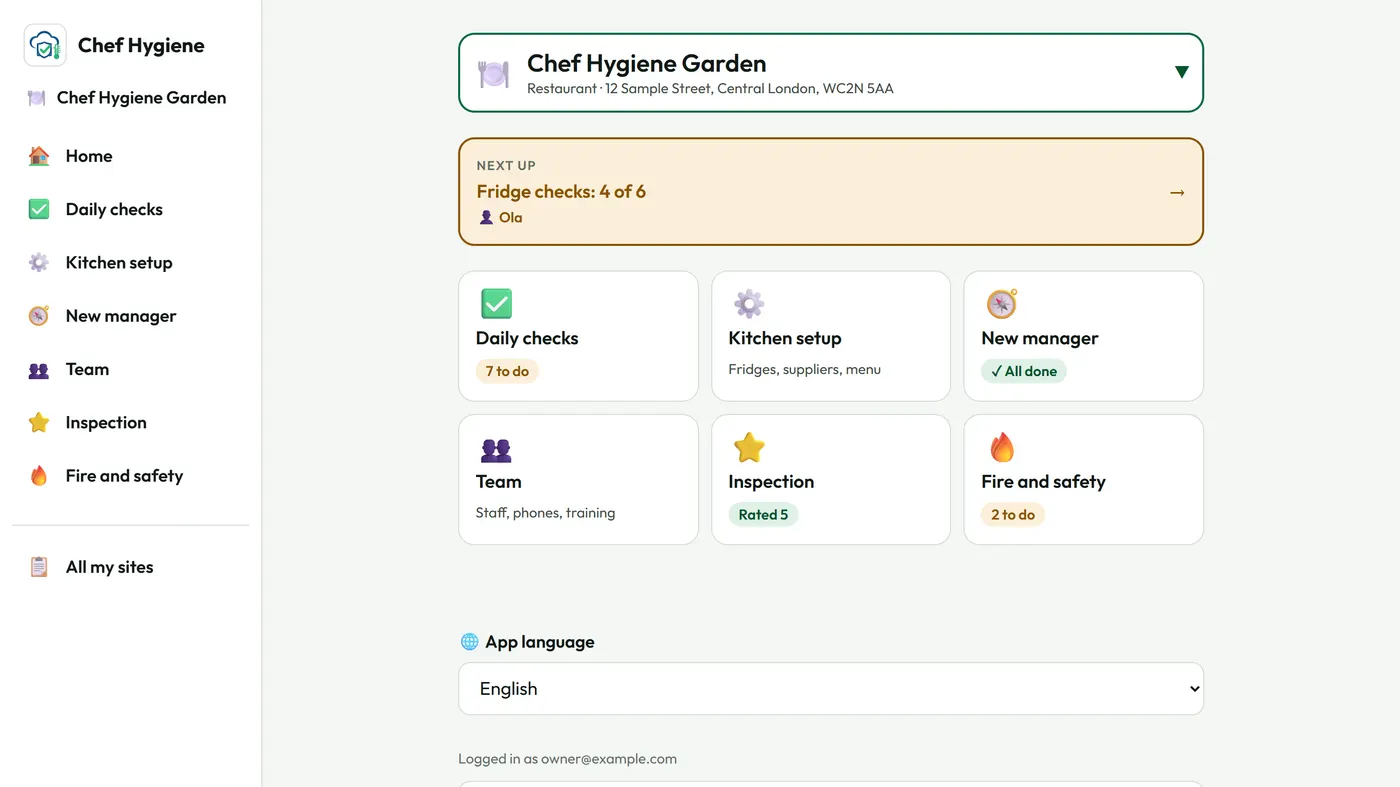
Stel Chef Hygiene in
Maak uw account aan, stel een gedeelde keukentablet in en zet de app stap voor stap op de telefoons van uw medewerkers.
Oostenrijk: voedselinspecties
Wie inspecteert uw keuken, hoe een inspectie werkt en of er een keuring voor de openbare hygiëne bestaat.
Oostenrijk: regels voor voedseltemperatuur
De voedseltemperaturen die uw keuken moet behouden, en de regels daarachter.
Oostenrijk: allergenen
Wat uw keuken klanten moet vertellen over allergenen.
Oostenrijk: ziekte en opleiding van het personeel
Training, regels voor voedselbehandelaars en wanneer ziek personeel van voedsel weg moet blijven.
Oostenrijk: brandveiligheid
Brandveiligheidscontroles voor uw keuken en hoe vaak deze moeten plaatsvinden.
Oostenrijk: gegevens die moeten worden bewaard
De administratie en registraties die uw keuken moet bijhouden.
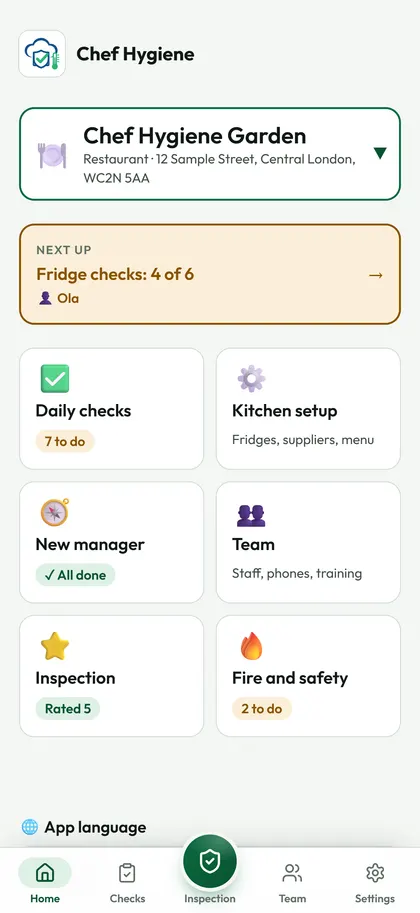
Oostenrijk: de Chef Hygiene-app
De app laadt deze regels voor uw keuken in, controleert uw administratie aan de hand daarvan en bewaart het bewijs voor de inspecteur.
Andere landen
 Verenigd Koninkrijk
 Ierland
 IJsland
 Verenigde Staten
 Canada
 Frankrijk
 Spanje
 Nederland
 België
 Portugal
 Duitsland
 Polen
Polen Roemenië
 Italië
 Griekenland
 Denemarken
 Zwitserland
 Luxemburg
 Cyprus
 Malta
Malta Zweden
 Noorwegen
 Finland
 Tsjechië
 Hongarije
 Kroatië
 Bulgarije
 Slowakije
 Slovenië
 Estland
 Letland
 Litouwen
 Liechtenstein
 San Marino
 Gibraltar
 Monaco
 Moldavië
 Andorra
 Servië
 Jersey
 Guernsey
 Isle of Man
 Turkije
 Montenegro
 Bosnië en Herzegovina
 Kosovo
 Albanië
 Noord-Macedonië
 Oekraïne